In this guide
- Why Apartment Landlords and Condo HOAs Mandate Floor Runners & Door Jamb Guards
- Protection Costs by Building Class: Mover Surcharges vs. HOA Holds vs. DIY Gear
- Masonite Sheets vs. Rosin Paper vs. Non-Slip Neoprene & Canvas Runners
- Building-Safe Runners and Uniform Boxes That Prevent Hallway Scuffs
- 5-Step Pre-Move Checklist to Clear Building Rules Without Extra Charges
Why Apartment Landlords and Condo HOAs Mandate Floor Runners & Door Jamb Guards
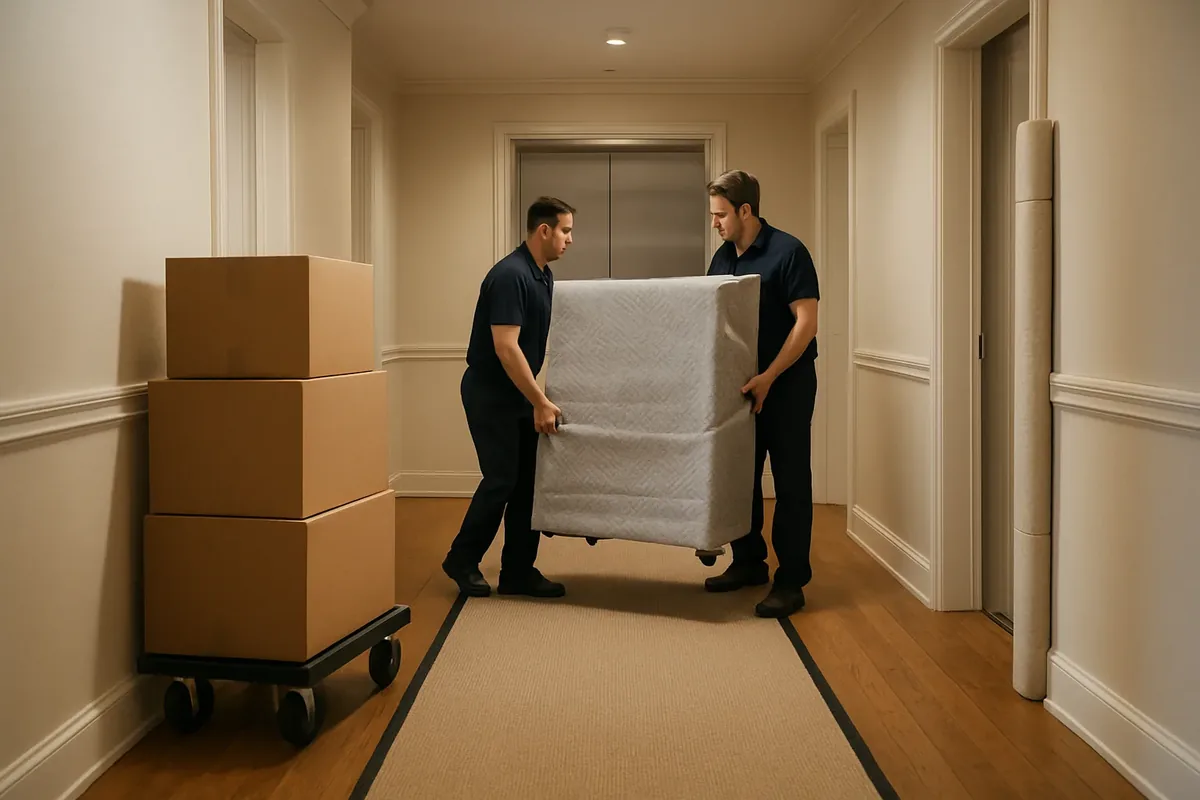
Every time a four-wheel hand truck loaded with 400 pounds of corrugated book boxes or a solid-oak dresser rolls out of an apartment unit, two surfaces absorb the impact: finished wood or stone flooring beneath the caster wheels, and the 32-to-36-inch painted pine door frame you squeeze through on every trip. One embedded piece of parking-lot gravel under a polyurethane dolly wheel carves a permanent gouge across luxury vinyl plank or white oak flooring, while one clipped dresser corner rips away quarter-round door casing.
To prevent common-area damage, nearly all mid-rise rental buildings, luxury concierge towers, and private HOA condos enforce strict move-in rules alongside their Certificate of Insurance (COI) process. Even in smaller 2nd- and 3rd-floor walk-up apartment buildings without concierge desks, landlord move-out inspections regularly withhold $150 to $450 from your apartment security deposit for scuffed entry thresholds, tracked rain stains on hallway carpet, or chipped drywall corners.
Protection Costs by Building Class: Mover Surcharges vs. HOA Holds vs. DIY Gear
Whether you pay full-service movers ($125–$295/hr plus $75–$145 local transport) or rent a 12-to-20-ft DIY truck ($30–$55 daily base plus $1.09–$1.59/mi), building protection fees scale sharply with building management tier. Many local movers omit 'Masonite & Jamb Protection' from phone quotes and add $15 to $35 per hardboard sheet or $50 to $175 flat—plus 15 to 30 minutes of hourly crew prep time—once they read the concierge's check-in sheet.
| Apartment Building Tier & Access Profile | Typical Building Fee / Security Deposit Risk | Full-Service Mover Protection Charge + Setup Time | Standard Local Move Base (1BR / 2BR, <15 Mi) | DIY Protection Strategy & Risk Control |
|---|---|---|---|---|
| Walk-Up Apartment (2nd–5th Floor, Hardwood Entry) | $150–$450 security deposit deduction for casing dings | $40–$95 runner/pad setup (+0.5–3.0 stair hrs) | $725 – $2,140 + $55–$340 stair fee | Own 27" × 24 ft rubber-backed runner + 3 jamb pads |
| Managed Mid-Rise (4–8 Floors, Carpeted Corridor) | $150–$300 move fee + $250–$500 deposit | $50–$120 Masonite/film fee (+0.5–1.0 freight hr) | $770 – $2,235 (incl. $45–$95 freight fee) | Peel-clean 3-mil carpet film + uniform stacked boxes |
| Luxury High-Rise (Marble Lobby + Reserved Freight Cab) | $250–$500 move fee + $500–$750 deposit | $75–$175 Masonite + jamb guard package | $770 – $2,235 (incl. $45–$95 freight fee) | Confirm concierge lays lobby Masonite; protect unit door |
| Private HOA Condo / Co-Op (Strict COI & Rule Fines) | $300–$650 move fee + $500–$1,500 deposit | $100–$225 mandatory full-path protection | $1,170 – $3,340 (2BR–3BR + freight fee) | DIY trucks often banned; verify $1M–$5M COI compliance |
Amazon US Apartment Moving Supplies
Recommended Moving Boxes, Blankets & Bags for This Move
Apartment moving supplies matched to this guide (Amazon.com affiliate ID: apartmentmovingcost-20).
Trimaco Stay-Put Canvas Plus Slip-Resistant Hallway Floor Runner 27" x 24 ft
Rubber-backed absorbent canvas floor runner protecting hardwood and lobby carpet from wet dolly tracks
Uboxes 1–2 Bedroom Smart Moving Box Bundle (35 Boxes + Packing Supplies)
Complete 35-box apartment relocation bundle with kitchen, book, and linen cartons plus tape rolls
Bankers Box SmoothMove Prime 1–2 Bedroom Tape-Free Moving Box Kit (28-Pack)
Reinforced double-bottom fast-fold moving boxes with pre-cut carry handles requiring zero tape
As an Amazon Associate I earn from qualifying purchases. Always verify live stock and pack sizing directly on Amazon.com.
Masonite Sheets vs. Rosin Paper vs. Non-Slip Neoprene & Canvas Runners
When choosing floor protection—or evaluating what your moving company brings into your unit—material traction and edge stability matter far more than thickness alone. Several inexpensive materials actually create slip hazards or peel lacquer straight off freshly refinished hardwood floors.
- Red Rosin Paper & Thin Painter Plastic (Avoid for Heavy Dollies): Taped brown Kraft paper or 2-mil plastic tears on the second dolly pass, bunches under heels, and turns wet shoes into an indoor ice rink for movers carrying 180-lb dressers.
- 4' × 8' Tempered Masonite Hardboard Panels: The gold standard for luxury high-rise stone lobbies where piano or 800-lb safe dollies roll; heavy and bulky to haul yourself, so buildings or full-service movers typically handle lobby Masonite while you protect inside your unit.
- Rubber-Backed Non-Slip Canvas Runners (27" × 24 ft): Ideal for apartment hardwood foyers, tile hallways, and rainy-day moves because the non-slip rubber underside grips floors flat with zero painter's tape while absorbent canvas traps mud and snow.
- Neoprene & Quilted Spring-Clamp Door Jamb Guards (54" Tall): Snap onto interior apartment doors and main corridor jambs in 10 seconds without adhesive, cushioning hinge pins, brass strike plates, and sharp wooden trim against refrigerator and sofa frames.
Building-Safe Runners and Uniform Boxes That Prevent Hallway Scuffs
Protecting your security deposit and avoiding mover setup markups takes two simple components: a self-anchoring runner that traps wet tire marks without tape, and rigid corrugated cartons that stack squarely on a dolly so loads never tip into corridor drywall. Laying down the Trimaco Stay-Put Canvas Plus Slip-Resistant Hallway Floor Runner 27" x 24 ft straight from your apartment threshold across your living room hardwood creates a 24-foot non-slip rubber-backed runway that handles muddy boots and rubber hand-truck wheels cleanly and shakes out for reuse on your move-in destination.
Box geometry plays an equally direct role in avoiding wall gouges: sagging grocery cartons bulge outward past a 20-inch dolly frame and scrape hallway paint on every trip. Packing with the Uboxes 1–2 Bedroom Smart Moving Box Bundle (35 Boxes + Packing Supplies) gives your movers uniform 32-ECT single-wall boxes that stack vertically within the exact footprint of a four-wheel cart. If you want rapid zero-tape assembly with double-end and double-bottom durability plus smooth cut-out carry handles that keep knuckles away from tight door frames, the Bankers Box SmoothMove Prime 1–2 Bedroom Tape-Free Moving Box Kit (28-Pack) locks cleanly without collapsing mid-hallway.
5-Step Pre-Move Checklist to Clear Building Rules Without Extra Charges
- Download Your Building's Move-In Rules PDF 14 Days Ahead. Look specifically for clauses mentioning 'Masonite required in lobby,' 'neoprene floor runners inside units,' 'elevator pad installation,' and exact COI endorsement wording so neither you nor your movers get surprised at check-in.
- Ask Your Estimator If Floor & Door Jamb Protection Is Included. Send the building's rules PDF to your moving estimator and verify in writing whether door jamb guards, corner protectors, and hallway runners are part of their base hourly rate or billed as a $50–$175 add-on.
- Lay Your Own Inside-Unit Runner Before Crew Arrival. Roll out your 24-foot non-slip runner from the unit door into the kitchen and bedroom corridor at 7:45 AM; saving your crew 20 minutes of taping paper cuts $45 to $80 off hourly labor.
- Photograph Entry Door Molding and Lobby Trim Before Box One Moves. Snap timestamped wide photos of your front door jamb, hallway corner drywall, and elevator threshold so an HOA cannot blame your move for pre-existing scuff marks.
- Assign One Helper to Remove Interior Doors Off Hinge Pins for Tight Sofas. Popping an interior bedroom or bathroom door off its three hinge pins takes 60 seconds with a flat screwdriver and adds 2 full inches of clearance—saving door trim and avoiding jammed couches.
Estimate total mover labor, building protection surcharges, and DIY supply savings in our Apartment Moving Cost Calculator or Movers vs. DIY Rental Truck Comparator.
Open Calculator →Frequently Asked Questions
Who supplies the floor runners and elevator pads on an apartment move—the building or the movers?+
In most luxury high-rises charging a $150–$500 non-refundable move fee, building maintenance hangs the padded elevator cab blankets and lays Masonite panels in the ground-floor lobby, while your moving crew is responsible for doorway jamb guards and runners leading into your apartment unit. Always check your resident handbook so there is no gap at the hallway threshold.
Can movers charge extra for Masonite or neoprene floor runners on top of my hourly quote?+
Yes—if your estimate did not explicitly include building protection materials, movers frequently add $50 to $175 for Masonite boards, corner guards, and runner deployment, plus the hourly labor time (typically 15 to 30 minutes at $130–$235/hr) spent taping boards down and lifting them afterward.
Are neoprene door jamb guards better than taping moving blankets over apartment doors?+
Yes. Taping a heavy 80-lb moving blanket onto painted door trim risks pulling paint off when tape is removed and often leaves the sharp brass strike plate exposed where a sofa leg clips the frame. Spring-clamp neoprene jamb guards grip cleanly in seconds without tape, leave zero residue, and bounce back after impact.
Do I still need floor protection if I hire a DIY rental truck and move on a sunny day?+
Yes—especially on engineered hardwood, bamboo, or luxury vinyl plank floors common in modern apartments. Even dry parking-lot pebbles trapped in shoe treads or hand-truck rubber wheels can scratch soft hardwood topcoats during 40+ round trips, easily triggering $200+ in move-out floor refinishing deductions.
What happens if my mover arrives without required floor protection at a strict condo HOA?+
The concierge or dock marshal can deny freight elevator access until compliant runners or Masonite are laid—leaving your moving crew sitting on the clock at $130 to $295/hr (or facing California Double Drive Time / minimum-hour guarantees) while you scramble to buy supplies at a nearby hardware store.
Interactive US Moving Tools
Compare Full-Service Movers vs. DIY Rental Truck in 30 seconds
Related Guides
apartment moving cost guides
Apartment Moving Cost Guides: Complete US Hourly Rates, Flat-Rate Quotes & Benchmarks
Local US apartment moves with licensed full-service crews average $640 to $1,530 for studios and 1-bedroom units and $1,270 to $3,572 for 2- and 3-bedroom apartments when self-packed, while DIY rental trucks run $155 to $507. This pillar guide decodes hourly crew math, travel fees, access surcharges, FMCSA estimate rules, and packing material ratios across every moving scenario.
apartment moving cost guides
Shared Elevator Cycle Delay Minutes: Calculating the Real Labor Cost of Unreserved Elevators
Moving out of a mid-rise or high-rise without a locked freight elevator forces movers to compete with commuting neighbors and delivery drivers on every trip. Learn how shared elevator cycle delay minutes translate into $130 to $411 in extra hourly crew labor—and how to slash cab wait time.
apartment moving cost guides
Low-Clearance Apartment Garages: Avoiding $5,000 Truck Roof Hits & Loading Dock Fines
Most residential underground parking garages are built with 6 ft 8 in to 7 ft 2 in vertical clearance bars, while even the smallest 10-foot rental box truck stands 8 ft 7 in to 9 ft 6 in tall. Here is how to avoid $3,500 to $8,500 in excluded overhead collision liability and budget for long-carry curb staging.
apartment moving cost guides
Moving Into a Furnished Sublet: Boxes-Only & Micro-Load Apartment Pricing
Relocating into a furnished sublet or corporate apartment cuts your shipment volume from 420 cubic feet down to 90–160 cubic feet of boxes, clothing, and a desk setup. Learn how mover minimum-hour rules work and when a cargo van or micro-load crew saves $250 to $450.