In this guide
- Why Split-Level Mezzanine Stairs Cause High Security-Deposit Deductions
- How to Measure Stair Turn Clearance Before Moving Day
- Targeted Padding: 90-lb/dz Supreme Blankets, Elastic Straps & Leg Booties
- 6-Step Clearance Audit & Wall-Protection Protocol
- DIY Protection Kit Cost vs. Mover Packing & Tight-Clearance Waivers
Why Split-Level Mezzanine Stairs Cause High Security-Deposit Deductions
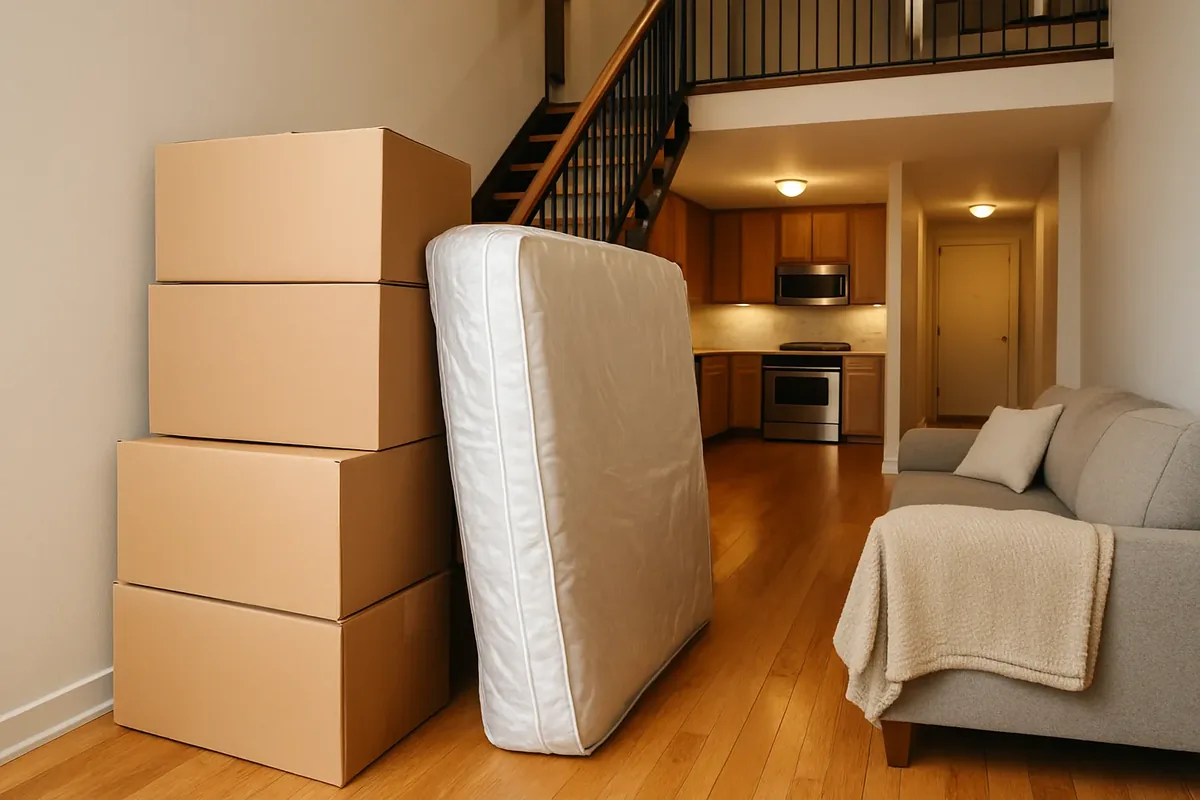
Standard apartment hallways give carriers 42 to 48 inches of straight wall-to-wall width and 9-foot ceilings. By contrast, split-level mezzanine and sleeping-loft staircases inside converted warehouses and modern duplex apartments are tucked into compact floor footprints—often just 30 to 36 inches wide between drywall and open balusters, with ceiling joists dipping below 80 inches directly over the lower steps. When movers swing a dining table corner or upright dresser past that pinch point, bare wood legs gouge soft drywall corner beads while steel fasteners bend painted metal railings.
Landlords rarely treat deep stairwell gashes as normal wear and tear. Patching torn corner bead, feathering texture, and repainting an entire double-height loft wall routinely runs $250 to $650 out of your security deposit, while refinishing gouged oak stair treads or replacing a custom glass baluster pushes deductions past $900. Investing in a targeted protection kit and auditing every turn clearance 48 hours ahead saves both your deposit and 30 to 45 minutes of hourly mover time ($65–$176).
| Stair & Furniture Pinch Point | Minimum Clearance Threshold | Recommended Protection Spec | DIY Gear Kit vs. Mover Packing | Typical Unprotected Damage Deduction |
|---|---|---|---|---|
| 90° Drywall Turn & Metal/Wood Banister | 32–36 in width; 80+ in headroom | 75 lb/doz quilted pads + elastic straps | Included in $95–$235 DIY kit / $290–$820 mover | $250 – $650 (Corner bead + double-height paint) |
| High-Gloss Walnut Tables & Glass Credenzas | Diagonal < landing diagonal minus 3 in | 90 lb/doz ultra-thick supreme moving blankets | Supreme pad protection; saves finish claims | $300 – $900+ (Furniture refinishing / replacement) |
| Tapered Sofa, Chair & Dining Table Legs | Remove legs if sofa depth > door width | 14" elasticated quilted leg protector booties | Fast slip-on cuffs; zero tape adhesive | $150 – $400 (Wood tread gouges & broken legs) |
| King / Queen Memory Foam Mattress | Must flex smoothly around 180° loft turn | 180-GSM tarp mattress bag with 8 handles + zip | Replaces flimsy 1.5-mil covers | $150 – $350 (Ripped fabric + plaster rail scuffs) |
| Base 1BR–2BR Local Move With Mezzanine | 1–2 Flights ($55–$190 flat surcharge) | +0.5–1.75 hrs ($130–$235/hr + $75–$145 trans.) | $940–$2,744 Full-Service / $142–$316 DIY Truck | Pre-padding cuts +0.5 hr delay ($65–$118 saved) |
How to Measure Stair Turn Clearance Before Moving Day
Guessing whether an 86-inch sofa or 72-inch walnut media console clears a split-level landing costs valuable hourly clock time when a crew gets wedged halfway down the stairs. Grab a 25-foot tape measure and check three dimensions on every piece stored upstairs:
- Clear Stair Width vs. Narrowest Furniture Dimension: Measure inside-to-inside between the drywall and the inner face of the handrail (not tread edge to wall). If clear width is 31 inches and your dresser depth is 19 inches, it fits horizontally—but a 34-inch-tall armchair with fixed legs may pinch unless tipped diagonally.
- Overhead Ceiling Joist Pinch (Headroom Clearance): Stand midway down the mezzanine steps and measure straight up from a tread nosing to the bottom corner of the upper loft fascia. Any headroom below 78 inches blocks upright vertical sofa pivoting and forces horizontal carries.
- Landing Diagonal vs. Sofa Diagonal Depth: Measure corner-to-corner across the bottom stairwell landing and compare against the sofa's diagonal depth (front skirt to upper back frame). Removing 4-to-6-inch tapered wooden legs drops most sofas below 30 inches of pass-through depth.
Amazon US Apartment Moving Supplies
Recommended Moving Boxes, Blankets & Bags for This Move
Apartment moving supplies matched to this guide (Amazon.com affiliate ID: apartmentmovingcost-20).
Elasticated Quilted Chair, Sofa & Table Leg Protector Booties (16-Pack)
Padded slip-on cuffs protecting wooden furniture legs from concrete sidewalk scrapes during truck loading
Sure-Max 4 Ultra-Thick Supreme Moving Blankets 80" x 72" (90 lb/dz Extra-Heavy)
Maximum-loft 90-lb/dozen padded blankets for high-gloss walnut tables, pianos, and glass credenzas
VEVOR 12-Pack Heavy-Duty 80" x 72" Quilted Moving Blankets with 2 Elastic Straps
Recycled cotton-fill non-woven moving pads bundled with two heavy elastic securing bands
As an Amazon Associate I earn from qualifying purchases. Always verify live stock and pack sizing directly on Amazon.com.
Targeted Padding: 90-lb/dz Supreme Blankets, Elastic Straps & Leg Booties
Cheap thin felt pads flatten under one sharp corner bump against an aluminum stair trim strip. For centerpiece items descending split-level stairs—high-gloss walnut dining tables, glass credenzas, lacquer dressers, and framed artwork—upgrade to Sure-Max 4 Ultra-Thick Supreme Moving Blankets 80" x 72" (90 lb/dz Extra-Heavy), whose 90 lb/doz supreme cotton/polyester batting loft absorbs hard knocks against wall corners without transferring dents to wood veneer.
Armoring the staircase itself and lining the truck interior requires full coverage across banisters, newel posts, and drywall flanks. Wrapping railings with VEVOR 12-Pack Heavy-Duty 80" x 72" Quilted Moving Blankets with 2 Elastic Straps (75 lb/doz recycled cotton-fill pads with two heavy elastic bands) lets you cinch pads securely around stairwell posts in seconds with zero tape residue on painted balusters. Finish by slipping Elasticated Quilted Chair, Sofa & Table Leg Protector Booties (16-Pack) (14-inch-tall quilted cuffs with elastic tops) onto dining chair legs and exposed sofa feet so narrow corners never chip veneer or scratch concrete outside your truck ramp. Finally, zip king or queen mattresses inside a 180-GSM woven tarp mattress bag with 8 sewn handles so two movers steer floppy foam around tight turns without brushing walls.
6-Step Clearance Audit & Wall-Protection Protocol
- Measure Width, Headroom, and Landing Turns 48 Hours Out. Confirm every upstairs item's smallest dimension clears the stair width and soffit headroom; mark any sofa legs or bed headboards that must be unbolted.
- Pad the Mezzanine Handrail, Newel Post, and Lower Corner Bead. Drape 75-lb/doz quilted blankets over the staircase handrail and bottom drywall turn, locking them tightly with wide elastic bands or stretch film.
- Slip Quilted Booties Onto Dining Chairs and Sofa Feet. Cover exposed wooden legs with 14-inch elasticated quilted booties before moving pieces out of bedrooms, preventing scuffs on both oak stair treads and hallway trim.
- Double-Wrap High-Gloss Tables and Glass With 90-lb/dz Blankets. Wrap fragile walnut tabletops, mirror frames, and glass credenzas completely inside 90-lb/doz ultra-thick supreme moving blankets before leaving the upper floor.
- Load Mattresses Into 8-Handle Tarp Bags Before Stair Descent. Zip mattresses into heavy woven tarp bags so carriers grip reinforced corner handles cleanly instead of squashing bare ticking against dusty banister spindles.
- Keep One Spotter at the Bottom Turn During All Heavy Carries. Position a spotter below the soffit pinch point to call clearances on blind corners—protecting your security deposit and avoiding extra hourly repair delays.
DIY Protection Kit Cost vs. Mover Packing & Tight-Clearance Waivers
Outfitting your own mezzanine protection and box kit runs $95–$160 for a 1-bedroom (12 blankets, 1 mattress bag, 5 tape rolls, and 35 cartons) or $145–$235 for a 2-bedroom (18 blankets, 2 mattress bags, 7 tape rolls, and 52 cartons), whereas hiring movers to supply and pack everything climbs to $290–$520 (1BR) or $460–$820 (2BR). Just as important, pre-padding railings and removing sofa legs avoids signing a carrier Tight-Clearance Waiver—protecting both your apartment security deposit and full valuation rights beyond standard $0.60/lb Released Value coverage.
Want to budget both your protection gear and full stair moving labor accurately? Plug your unit size, stair flights, and self-pack savings into our Apartment Moving Cost Calculator or run a full comparison in the Movers vs. DIY Rental Truck Comparator.
Open Calculator →Frequently Asked Questions
What is the minimum stairwell width to move a standard sofa down mezzanine loft stairs?+
Most standard 34-to-36-inch-deep sofas require at least 31 to 32 inches of clear stairwell width after removing tapered wooden legs—and sufficient headroom (typically 80+ inches) to angle diagonally around any 90-degree bottom turn. Measure your smallest sofa dimension against the handrail-to-wall gap before moving day.
Do moving companies bring their own wall and banister protection, or do I pay extra?+
Reputable full-service movers bring quilted furniture blankets and basic neoprene door-jamb guards on their truck at no extra rental charge for local moves, though specialized Masonite floor protection and extensive tape/shrink-wrap rolls can add to your materials bill ($290–$520 for a 1-bedroom or $460–$820 for a 2-bedroom if movers supply all boxes and wrapping). Pre-padding your own railings saves time on the hourly clock.
How thick should moving blankets be to prevent drywall and walnut dresser damage on stairs?+
Skip thin 40–50 lb/dozen economy mover skins for tight stairs. Use 75 lb/dozen quilted non-woven pads for banisters and standard furniture, and step up to 85–90 lb/dozen heavy-duty or supreme quilted blankets for high-gloss walnut tables, glass credenzas, and sharp corner turns.
Are movers liable for scuffed mezzanine drywall if I skip pre-wrapping or insist on tight carries?+
Standard Released Value protection ($0.60 per pound per article) covers minimal cargo damage, not always tight architectural pinch points—and movers often ask renters to sign a Tight-Clearance Damage Waiver before forcing oversized sofas through undersized mezzanine stairwells. Disassembling pieces beforehand eliminates waiver risk.
How much does a DIY protection kit cost compared with typical landlord stairwell repair fees?+
Outfitting a 1-bedroom or 2-bedroom move with DIY boxes, heavy blankets, stretch wrap, and mattress bags runs $95–$160 (1BR) or $145–$235 (2BR), whereas a single drywall corner repair, double-height loft repaint, or gouged oak tread refinish commonly triggers $250–$900 in deposit deductions.
Interactive US Moving Tools
Compare Full-Service Movers vs. DIY Rental Truck in 30 seconds
Related Guides
walk up stairs and elevator moving costs
Walk-Up Stairs & Elevator Moving Costs: Complete US Benchmarks & Guides
Walk-up staircases, shared passenger elevators, and long-carry podium corridors routinely add $110 to $1,045 to a US apartment moving invoice through combined extra crew hours and flat tariff surcharges. This hub breaks down exact 2nd-to-5th-floor carry penalties, freight elevator booking rules, shuttle truck triggers, and the strapping gear that saves hours on moving day.

walk up stairs and elevator moving costs
Sunken Basement & English Garden Steps Moving Cost: Per-Flight Fees vs. Hourly Labor
Moving out of a sunken English basement or garden-level apartment adds $63 to $390 to a local US move depending on step count, iron gate clearance, and carrier tariff rules. Compare how movers price 5-to-10 sunken concrete steps using flat per-flight fees ($50–$90 / $55–$95) versus hourly labor.
walk up stairs and elevator moving costs
1-Bedroom Sunken Basement & Garden Steps Move: Extra Minutes & Quote Impact
Moving a 1-bedroom apartment (420 cu ft) up sunken English basement steps adds 30 to 60 minutes of crew carry time and $65 to $270 to a local quote. See the exact minute-by-minute breakdown across packing, loading, and metro mileage tiers compared to studios and DIY trucks.
walk up stairs and elevator moving costs
2-Bedroom Sunken Basement & Garden Steps: Why a 3rd or 4th Relay Mover Saves Hours
Trying to move a 2-bedroom English basement apartment (680 cu ft / 5,400 lbs) with only 2 movers creates severe sunken-step fatigue and balloons total hours. Learn why booking a 3- or 4-mover relay crew trims 3 to 4.5 hours off the clock and keeps total bills predictable.