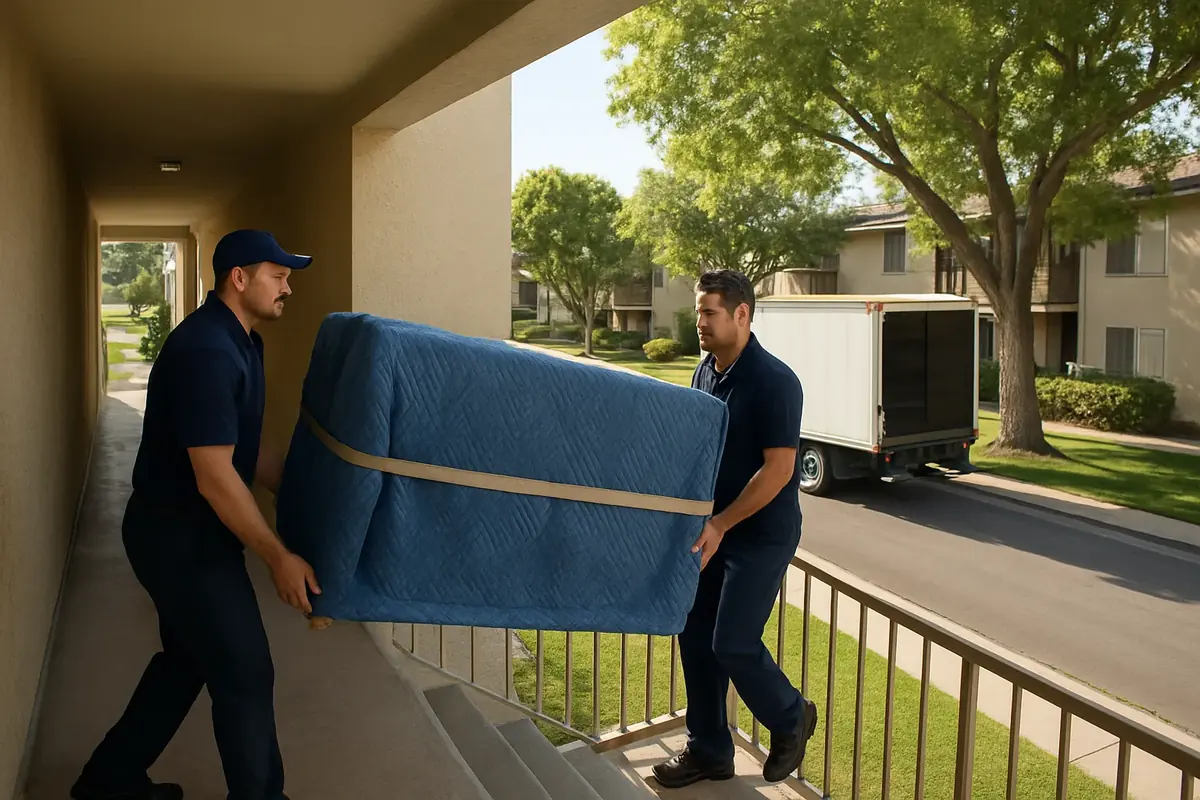
In this guide
- Why a 6th-Floor Tenement Walk-Up Destroys Unprepared Furniture and Walls
- Doorway Measuring & Diagonal Stair Turn Clearance Audit
- Floor Runner Prep & Stairwell Corner Protection That Protects Deposits
- Quilted Blanket Compression & Tarp-Handled Mattress Bag Technique
- 6-Step Pre-Move Staging Sequence to Shave Up to 75 Minutes Off Crew Time
Why a 6th-Floor Tenement Walk-Up Destroys Unprepared Furniture and Walls
Pre-war walk-up tenements built between 1890 and 1930 in Manhattan, Brooklyn, Boston's North End, South Philadelphia, and older Chicago neighborhoods were never engineered for modern queen pillow-top mattresses, 84-inch sofas, or dense particleboard dressers. From a 6th-floor unit down to street grade, every bulky item makes five consecutive 180-degree switchback turns across 36-inch to 42-inch landings, clears low plaster soffits, and brushes past narrow wooden handrails and radiator pipes. Without proactive wall, floor, and furniture protection, a single 5-flight descent commonly leaves deep plaster gouges, ripped upholstery corners, and scratched parquet thresholds that cost far more in security-deposit withholdings than a full roll of floor runner paper and a dozen moving blankets.
Unprepared padding also inflates your moving invoice. Under national apartment benchmarks, a 4th- or 5th-floor walk-up (3 to 4 flights) already adds 1.75 to 3.0 extra crew hours plus $185 to $340 in flat stair surcharges. Reaching the 6th floor (5 interior flights) pushes cumulative exertion even higher, typically adding 2.25 to 3.75 extra hours and $235 to $430 in flat per-flight fees on top of your base load time (4.0–6.0 hours for a 1-bedroom at $130–$175/hr, or 5.0–7.5 hours for a 2-bedroom at $175–$235/hr, plus a standard 1.0-hour travel fee). When a foreman arrives to find unbolted bed frames, loose dresser drawers, and zero hallway staging, the crew spends the first 60 to 90 minutes wrapping inside a cramped bedroom while the hourly meter ticks.
| Apartment Size & Crew | Base Labor + 1-Hr Travel | 5-Flight Stair Time & Flat Fee | Local Transport Fee | Materials Kit (DIY vs. Mover-Packed) | Pre-Staged Total vs. Unprepped Total |
|---|---|---|---|---|---|
| 1-Bedroom (420 cu ft, 3,200 lbs) — 2 Movers ($130–$175/hr) | $650 – $1,225 (5.0–7.0 hrs) | $528 – $1,086 (2.25–3.75 hrs + $235–$430 flat) | $75 – $145 | $95 – $160 DIY / $290 – $520 Mover-Packed | $1,348 – $2,616 Pre-Staged vs. $1,608 – $3,064 Unprepped |
| 2-Bedroom (680 cu ft, 5,400 lbs) — 3 Movers ($175–$235/hr) | $1,050 – $1,998 (6.0–8.5 hrs) | $629 – $1,311 (2.25–3.75 hrs + $235–$430 flat) | $75 – $145 | $145 – $235 DIY / $460 – $820 Mover-Packed | $1,899 – $3,689 Pre-Staged vs. $2,302 – $4,392 Unprepped |
| DIY 12–20 ft Rental Truck + Self-Packing (1BR / 2BR) | $0 Crew (or $170–$290 2-hr loader help) | $0 Carrier Stair Surcharge | $47 – $105 Truck + $4–$8 Fuel | $95 – $235 DIY Supplies + Blankets | $146 – $348 Pure DIY ($316 – $638 w/ 2-hr Helpers) |
Doorway Measuring & Diagonal Stair Turn Clearance Audit
Before tearing off a single strip of stretch film, run a tape measure across every choke point from your 6th-floor parlor down to the vestibule door. Tenement hallways frequently narrow to 31 inches at radiator covers or utility risers, while apartment entry doors average 29 to 32 inches clear once you account for the hinged door thickness. If a sofa frame measures 35 inches deep and 33 inches tall without removable legs, trying to pivot it around a 38-inch pie-winder landing guarantees crushed plaster and a stuck couch midway down flight four.
- Doorway Width vs. Diagonal Sofa Depth: Measure inside stop-to-stop width after pulling hinge pins off tight doors (gains 1.5 to 2 inches). Compare that width against your sofa's diagonal depth—measured from the front top edge of the backrest to the bottom back corner of the frame.
- Stairwell Overhead Soffit Clearance: Measure vertically from the outer edge of the third step down from each landing straight up to the bottom plaster edge of the flight above. Anything under 76 inches forces an 84-inch sofa to drop below a 45-degree tilt.
- Newel Posts and Mailboxes: Check the clearance between the ground-floor lobby inner door and street vestibule; tight Victorian vestibules often trap king box springs that cleared every upper landing.
Amazon US Apartment Moving Supplies
Recommended Moving Boxes, Blankets & Bags for This Move
Apartment moving supplies matched to this guide (Amazon.com affiliate ID: apartmentmovingcost-20).
Scotch Stretchable 5-Inch Mini Bundling Wrap with Handle 5" x 1000 ft (2-Pack)
One-handed 5-inch mini stretch wrap dispenser for bundling silverware trays, cords, curtain rods, and remote controls
Goodwrappers Patented Brake-Handle 20" x 1000 ft Moving Stretch Film (2-Pack)
Built-in squeeze-brake paper handles allow tight high-tension wrapping around moving blankets without hand burn
Sure-Max 12 Pro Moving & Packing Blankets 80" x 72" (85 lb/dz Heavy-Duty Quilted)
Professional zig-zag double-stitched padded polyester/cotton blankets protecting dressers and door frames
As an Amazon Associate I earn from qualifying purchases. Always verify live stock and pack sizing directly on Amazon.com.
Floor Runner Prep & Stairwell Corner Protection That Protects Deposits
Floor and wall damage in a 6th-floor tenement happens in two predictable zones: the 10-foot foyer strip inside your apartment where heavy dressers pivot toward the exit, and the narrow shared hallways outside each landing. On hardwood apartment floors, gritty street debris tracked upstairs on work boots acts like coarse sandpaper under a sliding hand truck or tilted armoire. Laying overlapping 36-inch kraft rosin paper or heavy breathable floor board from your living room across the threshold—taped exclusively with low-tack painter's tape along the perimeter, never directly onto varnished oak—keeps shoe scuffs and dolly marks off landlord-inspected planks.
In the public tenement stairwell, focus protection at elbow and hip height (28 to 54 inches off the floor) on every outside drywall corner and wooden newel post. Taping corrugated cardboard corner guards onto protruding turn corners and draping spare moving pads over ground-floor vestibule glass or brass mailboxes absorbs accidental bumps when two carriers navigate a blind landing backward. Also pad the bottom threshold plate of your apartment door with a folded towel or scrap runner strip so metal appliance dolly blades never dent soft pine door sills.
Quilted Blanket Compression & Tarp-Handled Mattress Bag Technique
Thin cotton bedsheets or cheap single-ply painter tarps slip off mid-carry, snagging on stair rails and forcing carriers to set down a 140-lb dresser on a narrow step. Professional tenement crews rely on zig-zag stitched 85-lb per dozen quilted polyester/cotton moving blankets paired with high-tension 80-gauge brake-handle stretch film. By starting the film wrap around the base legs and tensioning upward with a squeeze-brake core, the stretch wrap compresses the quilted loft tightly against wood surfaces—preventing blanket sag while keeping drawer doors locked shut.
| Product | Physical Dimensions & Material Grade | Pack Configuration | Primary Tenement Protection Job |
|---|---|---|---|
| Sure-Max 12 Pro Moving & Packing Blankets | 80 x 72 in; 85 lb/doz heavy-duty zig-zag stitched quilted cotton/poly | 12 Blankets | Cushions hardwood dressers, dining tables, and sharp banister newel posts against plaster impacts |
| Goodwrappers Patented Brake-Handle Moving Stretch Film | 20 in x 1000 ft; 80-gauge high-tension cast film with squeeze-brake core | 2 Rolls + Brake Grips | Compresses quilted blankets snugly around furniture without loose tail flaps or hand friction burn |
| Scotch Stretchable 5-Inch Mini Bundling Wrap with Handle | 5 in x 1000 ft; 80-gauge narrow roll with built-in rotating dispenser | 2 Rolls + Handles | Quickly bundles unbolted bed slats, hardware bags, curtain rods, and wrapped silverware trays |
For mattresses descending five flights, standard 1.5-mil hardware-store dust covers tear on the first brick doorway threshold. Slide queen or king mattresses into a 5-mil puncture-resistant polyethylene mattress bag or a reinforced woven tarp/Oxford bag equipped with stitched perimeter carry handles, then add two diagonal bands of packing tape around the midsection to keep floppy pillow-top foam rigid enough for two carriers to steer vertically around tight stairwell bends.
6-Step Pre-Move Staging Sequence to Shave Up to 75 Minutes Off Crew Time
- Remove Protruding Legs, Knobs, and Glass Shelves. Unscrew sofa feet, dining table legs, and dresser pulls 24 hours ahead. Bag the hardware in labeled zip bags and tape each bag directly inside the corresponding dresser drawer or onto the underside of the tabletop using 5-inch mini bundling wrap.
- Tape Protective Floor Runners and Threshold Guards. Sweep grit off your living room and foyer floorboards, roll out heavy kraft paper or floor runners to the exterior threshold, and secure seams with blue painter's tape—leaving zero sticky residue for move-out inspection.
- Pad Wood Furniture with 85-Lb Quilted Blankets. Drape full 80x72-inch quilted blankets over dressers, bookshelves, and TV stands so zero wooden corners remain exposed, leaving a 2-inch gap above floor level if a carrier needs a handhold underneath.
- Lock Blankets Tight with 80-Gauge Brake-Handle Stretch Film. Wrap three overlapping horizontal passes from bottom to top while squeezing the brake grip so drawers stay immobilized and blanket edges never snag on stair spindles.
- Bag Mattresses and Stack 32-ECT Boxes by Weight Near the Exit. Seal mattresses inside 5-mil poly or handled bags, pack heavy books into 15x12x10-inch small 32-ECT boxes under 40 lbs, and stack uniform columns three-high within 8 feet of your apartment door.
- Verify Landlord COI and Curbside Staging Before 8:00 AM. Confirm whether your building requires a $1M–$2M Certificate of Insurance (COI) even for walk-up properties and cone or hold a legal curb space beside the front stoop to avoid an extra $65–$135 long-carry surcharge.
Want to see how pre-staging and 5-flight stair labor compare against a DIY rental truck on your exact apartment inventory? Enter your floor height and box count into the Apartment Moving Cost Calculator or run a side-by-side breakdown in the Movers vs. DIY Rental Truck Comparator.
Open Calculator →Frequently Asked Questions
How much does a 6th-floor tenement walk-up add to a local apartment move?+
Under US moving benchmarks, a 4th- or 5th-floor walk-up (3–4 flights) already adds 1.75 to 3.0 extra crew hours and $185 to $340 in flat surcharges. Extending to a 6th-floor walk-up (5 full flights) adds roughly 2.25 to 3.75 extra hours and $235 to $430 in flat flight fees—adding $528 to $1,086 on a 2-mover 1-bedroom job ($130–$175/hr) and $629 to $1,311 on a 3-mover 2-bedroom job ($175–$235/hr).
Why should I wrap furniture in 85-lb quilted blankets before movers arrive?+
If you hire a local hourly crew, waiting for two or three movers to pad and wrap 10 furniture pieces inside a tight tenement apartment typically burns 60 to 90 billable minutes—costing $130 to $353 in extra labor plus marked-up mover packing materials ($290–$820 vs. $95–$235 DIY). Pre-wrapping in 85-lb/dozen quilted blankets compressed with 80-gauge stretch film lets the crew begin descending immediately.
Do movers still charge a 1-hour travel fee and stair fees if I pre-stage everything?+
Yes. Most US local movers assess a standard 1.0-hour travel fee for depot-to-origin and destination-to-depot transit, plus published per-flight stair surcharges ($50–$90 per flight above the first floor) regardless of pre-staging. What pre-staging eliminates is wasted on-site hourly labor spent wrapping, disassembling, and clearing narrow hallways—plus any $65–$135 long-carry fee if you secure curb parking.
Can I use regular painter's plastic or bedsheets instead of 5-mil mattress bags and 85-lb blankets?+
No. Thin 1-mil drop cloths and cotton sheets tear instantly against rough brick entryways, exposed stair nosings, and cast-iron radiators on a 5-flight walk-up. True 5-mil polyethylene mattress bags or 600D Oxford zippered bags with handles protect upholstery from stairwell soot and rain, while 85-lb/dozen quilted pads absorb sharp impacts against wood banisters.
Do tenement walk-up buildings require a Certificate of Insurance (COI) on moving day?+
Many urban walk-up landlords and co-op boards still require a $1M–$2M general liability Certificate of Insurance (COI) naming the building LLC as Additional Insured 5 to 10 business days ahead—specifically to cover hallway plaster, marble vestibule tiles, and banister damage. Confirm COI wording in writing before booking so your movers are not turned away at the front stoop.
Interactive US Moving Tools
Compare Full-Service Movers vs. DIY Rental Truck in 30 seconds
Related Guides
walk up stairs and elevator moving costs
Walk-Up Stairs & Elevator Moving Costs: Complete US Benchmarks & Guides
Walk-up staircases, shared passenger elevators, and long-carry podium corridors routinely add $110 to $1,045 to a US apartment moving invoice through combined extra crew hours and flat tariff surcharges. This hub breaks down exact 2nd-to-5th-floor carry penalties, freight elevator booking rules, shuttle truck triggers, and the strapping gear that saves hours on moving day.
walk up stairs and elevator moving costs
Walk-Up to Walk-Up (Stairs at Both Ends) Moving Cost: Per-Flight & Hourly Surcharges
Moving from one walk-up apartment into another doubles both physical crew fatigue and vertical haul surcharges across origin and destination stairwells. Learn how US movers stack flat per-flight fees ($50–$90 per flight) against hourly labor billing, and see exact dollar benchmarks from 2nd-to-2nd up through 5th-to-5th floor moves.

walk up stairs and elevator moving costs
Studio & 1-Bedroom Time & Cost Added by Walk-Up to Walk-Up (Stairs at Both Ends)
Moving a studio (250 cu ft) or 1-bedroom apartment (420 cu ft) between two walk-up buildings adds 60 to 360 billable minutes and $235 to $1,730 in extra labor and stair tariffs. This pace breakdown tracks exactly how descending vs. ascending stairs slows a 2-mover crew and shows how lifting harnesses cut double-stair hours.
walk up stairs and elevator moving costs
2-Bedroom & 3-Bedroom Crew Sizing for Walk-Up to Walk-Up (Stairs at Both Ends)
Trying to save money with a 2-mover crew on a 2-bedroom or 3-bedroom walk-up to walk-up move routinely backfires as stair exhaustion pushes total duration past 11–14 hours. Discover how upgrading to a 3-mover or 4-mover staircase relay reduces total billable hours by 30% to 40% and prevents overtime blowouts.