In this guide
- Why 4 Flights of Walk-Up Stairs Magnify Scuff & Deposit Risk
- The 5-Point Clearance Measuring Checklist for 5th-Floor Walk-Ups
- Drywall Scuff Defense & Furniture Wrapping Costs: Mover Markups vs. DIY Supplies
- Essential Stretch Wrap, Sofa Cover & Wall-Guard Gear for 4 Flights
- Staging Sequence That Keeps Stairs Clear and Drywall Intact
Why 4 Flights of Walk-Up Stairs Magnify Scuff & Deposit Risk
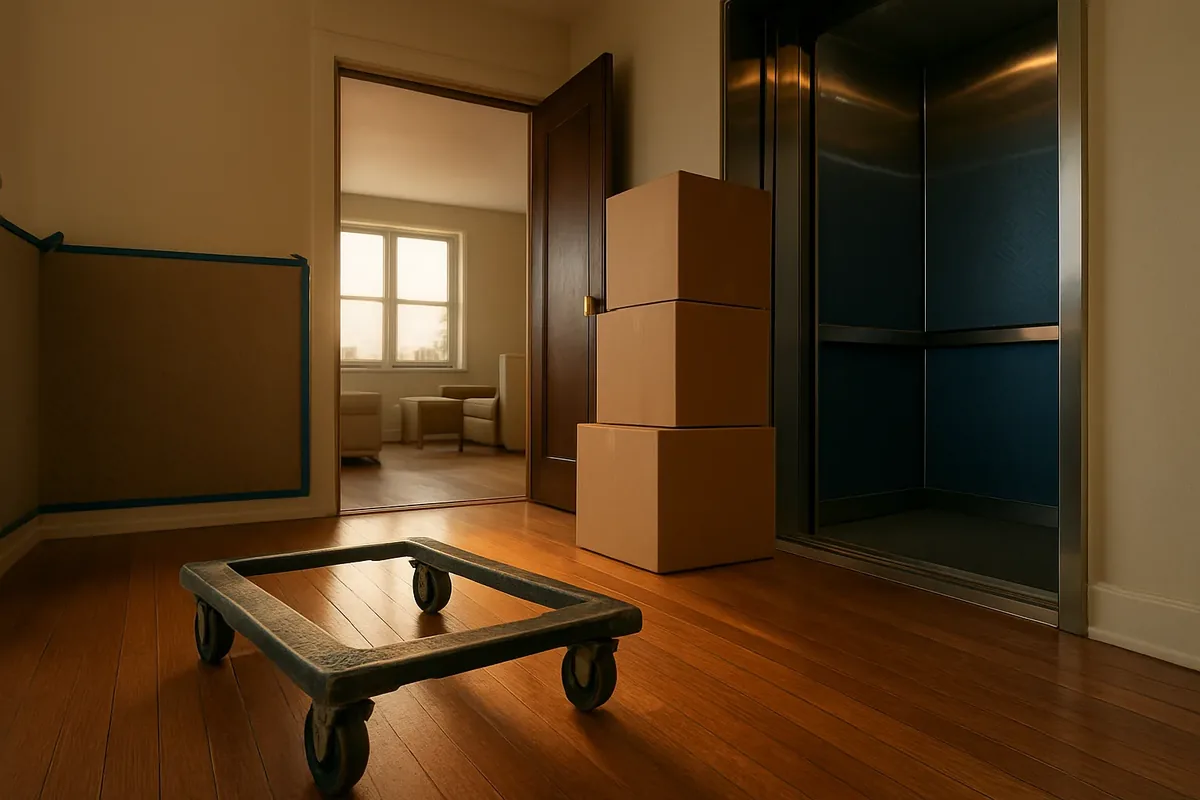
Moving down a 5th-floor walk-up multiplies collision geometry: instead of rolling smoothly through a 48-inch elevator cab and padded lobby, two carriers must pivot 80-inch sofas and tall dressers across 8 separate stairwell turns (4 half-landings and 4 full-floor landings) plus your apartment's own interior hallway and 30-to-32-inch entry door frame. Every exposed wooden furniture corner, protruding steel bed bracket, or dirty cardboard flap acts like sandpaper against painted drywall, metal corner beads, and stairwell banisters.
Under standard US residential leases, property managers treat common-hallway drywall gouges and ripped door casings outside 'normal wear and tear.' A single deep corner-bead dent on the 3rd-floor landing or black rubber wheel streak across semi-gloss hallway paint routinely triggers $250 to $650 in patching and repainting deductions—or forfeits an entire $500–$1,000 building move-out damage deposit. Even if you hire a full-service moving crew ($130–$175/hr for a 1BR; $175–$235/hr for a 2BR), carriers may add $50 to $175 for extra floor/wall protection and still carry zero liability for scuffed common walls if tight clearances leave less than 2 inches of turning margin.
The 5-Point Clearance Measuring Checklist for 5th-Floor Walk-Ups
Do not guess whether your sofa or armoire fits down 4 flights by eyeballing the front door. Three days before move day, grab a 25-foot metal tape measure and record five critical bottlenecks from your apartment bedroom all the way to the ground-floor exterior door:
- 1. Measure Net Doorway Opening Inside the Door Stop (Not Trim-to-Trim). Open each interior and entry door to 90 degrees and measure from the inside face of the door stop molding to the face of the open door slab itself. A nominal '32-inch door' frequently yields only 29.5 inches of clear opening unless you pop out the hinge pins to gain 1.75 inches.
- 2. Measure the Hallway-to-Doorway Pivot Box. Stand inside your apartment foyer and measure the hallway width directly outside the front door. If your front door opens into a 34-inch-wide interior corridor, a 78-inch-long rigid sofa cannot rotate horizontally through a 30-inch doorway unless it can stand vertically.
- 3. Check the Stairwell Overhead Soffit Clearance (Diagonal Headroom). Stand on each step halfway down a flight and measure vertically from the stair nosing straight up to the underside of the ceiling soffit above. Standard walk-ups run 78 to 84 inches; standing an 86-inch sofa vertically on its arm works on flat floors but hits the stairwell ceiling mid-flight.
- 4. Measure Landing Turn Depth and Newel-Post Width. At each half-landing, measure from the wall to the inner stair railing handrail (often 32 to 38 inches) and from the top step nosing to the back wall (landing depth). Compare these against your sofa's diagonal depth (measured from the top back edge to the front bottom frame corner—not seat cushion height).
- 5. Compare Item Dimensions Minus Legs and Cushions. Unscrewing 4-to-6-inch tapered sofa legs and removing loose back cushions often reduces a couch's diagonal depth from 36 inches down to 29 inches—the exact difference between scraping every drywall corner on 4 flights versus gliding cleanly past the handrails.
Amazon US Apartment Moving Supplies
Recommended Moving Boxes, Blankets & Bags for This Move
Apartment moving supplies matched to this guide (Amazon.com affiliate ID: apartmentmovingcost-20).
Heavy-Duty Clear 4-Mil Sofa & Couch Moving Protection Bag (Fits up to 96" Couch)
144"x46" slip-on clear 4-mil poly cover keeping upholstered fabric sofas clean inside rental trucks
80-Gauge Industrial Stretch Wrap Moving Film 15" x 1000 ft with Rolling Handles (2-Pack)
2,000 total feet of puncture-resistant 80-gauge self-clinging wrap with spinning ergonomic hand rollers
90-Gauge Black Opaque Heavy-Duty Stretch Wrap Film 15" x 1000 ft (2-Pack)
Opaque black 90-gauge stretch film concealing electronics and valuables during shared-elevator or storage moves
As an Amazon Associate I earn from qualifying purchases. Always verify live stock and pack sizing directly on Amazon.com.
Drywall Scuff Defense & Furniture Wrapping Costs: Mover Markups vs. DIY Supplies
Knowing how to wrap your furniture and pad high-impact drywall corners before move morning keeps both your furniture intact and your walls unmarked. Compare common building protection charges and damage risks against DIY commercial-grade wrap and cover specs below:
| Protection Target | Unprotected Walk-Up Risk & Cost | Pro Mover Billing / Surcharge | DIY / Commercial Prep Spec |
|---|---|---|---|
| 30–32 in Entry Door Jambs & Corridor Walls | $250–$650 security deposit deduction for chipped casing or drywall gouges | $50–$175 protection fee + 0.25–0.5 hr setup ($33–$118) | Folded flattened moving cartons + blue painter's tape over sharp drywall corners; remove door hinge pins |
| Upholstered Fabric / Velvet Sofas (up to 96 in) | $150–$400 upholstery cleaning or torn arm fabric on rough brick/wood rails | $25–$60 mover plastic sofa bag markup | Uboxes 4.0-mil clear sofa bag (144" x 46", fits up to 8-ft sofa) sealed with stretch film |
| Wood Dressers, Bookcases & Desks | $200–$800 gouged veneer and scuffed drywall from protruding drawer corners | Included blankets during transit, but unpadded DIY carries destroy walls | 85-lb quilted pads wrapped tight with PSBM 80-gauge clear cast stretch film (15" x 1000 ft) |
| TVs, PC Monitors & High-Value Electronics | Punched screens or visible theft temptation in open ground-floor walk-up lobbies | $40–$95 specialty mirror/TV carton + $50–$100 packing labor | Blanket pad + corrugated corner shields + BOMEI PACK 90-gauge black opaque privacy wrap |
| Mattresses & Box Springs (Twin to King) | Black stair grime, wet stoop stains, or ripped ticking on tight banisters ($300–$1,200 replacement) | $20–$45 mover mattress bag + slower 2-person grip on floppy foam | 5-mil poly cover OR 180 GSM 8-handle tarp bag so carriers steer around 8 tight landings |
Essential Stretch Wrap, Sofa Cover & Wall-Guard Gear for 4 Flights
Ordinary kitchen cling wrap tears the moment a wrapped dresser grazes a brick vestibule or wooden stairwell post, and single-layer paper pads slide right off during a steep 4-flight descent. Use industrial-gauge moving plastics and proper padded bags designed to handle friction down 50+ steps:
- Uboxes Heavy-Duty Clear 4-Mil Sofa & Couch Moving Protection Bag (Fits up to 96" Couch): Measuring 144" x 46" out of puncture-resistant 4.0-mil virgin polyethylene, this jumbo cover slips over sofas up to 8 feet wide, shielding fabric and velvet upholstery from dusty hallway walls, stairwell grease, and rental truck floor dirt.
- PSBM 80-Gauge Industrial Stretch Wrap Moving Film 15" x 1000 ft with Rolling Handles (2-Pack): Providing 2,000 total linear feet of tough 80-gauge cast film with spinning ergonomic hand rollers, this 2-pack locks quilted moving blankets tightly onto dressers, holds dresser drawers shut without adhesive tape residue, and cushions wood edges against drywall scuffs.
- BOMEI PACK 90-Gauge Black Opaque Heavy-Duty Stretch Wrap Film 15" x 1000 ft (2-Pack): Extra-thick 90-gauge privacy black stretch film protects padded electronics, desktop towers, boxed flat-screen TVs, and studio gear while concealing contents during ground-floor sidewalk staging outside a 5th-floor walk-up.
Staging Sequence That Keeps Stairs Clear and Drywall Intact
Even the best padding fails if helpers are tripping over stacked moving boxes on the 4th-floor landing or trying to balance a blanket-wrapped dresser around an open apartment door. Stage your 5th-floor unit the night before moving day using this drywall-safe order:
- Shield Wall Corners with Painter's Tape Only: Never use duct tape or clear packing tape directly on apartment drywall or painted trim—both peel off paint layers during removal, causing the exact deposit deduction you are trying to avoid. Use low-tack blue or green painter's tape to hang flattened cardboard L-shields on the 4 most exposed landing corners and the interior foyer turn.
- Band Every Quilted Pad Top-to-Bottom: When wrapping a wood dresser with quilted moving blankets, pull drawers out first (carry drawers separately or pack clothes in wardrobe boxes) to drop piece weight by 40 lbs, wrap the carcass in blankets, then run 3 vertical and 3 horizontal bands of 80-gauge stretch film so pads cannot slip toward the floor on steep stair tilts.
- Keep Stairwell Landings 100% Empty: Never stack boxes on hallway landings to 'stage halfway down.' Fire codes prohibit obstructing walk-up egress stairs, neighbors will trip, and carriers holding an 8-ft sofa lose critical foot placement on half-landings—leading directly to drywall punches.
- Seal Sofa Bags Tight Before Entering the Stairwell: Leaving slack plastic dangling at the ends of a 4-mil sofa bag creates a tripping hazard on stairs. Slip the couch inside the Uboxes 4-mil bag inside your living room, fold the excess length flat against the bottom frame, and run two quick bands of stretch wrap around the middle to keep the silhouette slim.
Budgeting your full 5th-floor walk-up move including floor protection, packing supplies, and stair surcharges? Calculate your exact estimate in the Apartment Moving Cost Calculator or weigh crew quotes against a DIY rental truck in the Movers vs. DIY Rental Truck Comparator.
Open Calculator →Frequently Asked Questions
How wide does a walk-up stairwell need to be to move a standard queen mattress and sofa down 4 flights?+
A standard 80-to-84-inch sofa usually requires at least a 30-inch clear doorway (achieved by removing legs and popping door hinge pins) and a 34-to-36-inch stairwell width with 80+ inches of vertical soffit clearance to stand vertically at turns. Innerspring queen mattresses (60 x 80 in) cannot fold sharply and struggle in tight pie-winder stairs narrower than 32 inches, whereas memory-foam mattresses can be rolled or vacuum-compressed and strapped tightly.
Do movers automatically bring wall and floor protection for a 5th-floor walk-up?+
Licensed movers include quilted moving blankets (typically 85-lb pads per dozen) for your furniture inside the hourly rate, and most carry floor runners for your apartment entryway. However, crews do not routinely tape cardboard shields across 4 stories of common hallway drywall unless requested—and high-rise/managed building protection setups commonly add $50 to $175 plus 15 to 30 minutes of billed prep time.
Why should I wrap dresser drawers in stretch film instead of leaving them loose or using packing tape?+
Acrylic or hot-melt packing tape leaves sticky residue and rips stained wood veneer or lacquered finishes right off dressers when peeled after the move. Self-clinging 80-gauge cast stretch wrap adheres strictly to itself without touching paint or lacquer, locks loose drawers shut during steep 4-flight carries, and pins quilted moving blankets securely in place.
Can I tape cardboard wall guards onto painted apartment hallway walls safely?+
Yes—as long as you stick strictly to fresh low-tack painter's tape (blue or delicate-surface purple tape) applied cleanly over dry paint and removed the same evening before adhesive cures. Avoid masking tape, gaffer tape, or packing tape on common hallway drywall, and fold flattened 32-ECT medium boxes into 90-degree corner bumpers over protruding landing edges.
Is a 4-mil sofa bag or stretch wrap alone better for carrying a fabric couch down 4 flights?+
Slipping the sofa inside a dedicated 4.0-mil clear sofa bag first and adding two snug outer bands of 80-gauge stretch film gives the best protection. Stretch film wrapped directly over textured boucle, linen, or velvet upholstery traps moisture if moving in rain/humidity and can pull delicate weaves if snagged on a handrail, whereas a 4-mil poly slipcover slides smoothly without catching fabric.
Interactive US Moving Tools
Compare Full-Service Movers vs. DIY Rental Truck in 30 seconds
Related Guides
walk up stairs and elevator moving costs
Walk-Up Stairs & Elevator Moving Costs: Complete US Benchmarks & Guides
Walk-up staircases, shared passenger elevators, and long-carry podium corridors routinely add $110 to $1,045 to a US apartment moving invoice through combined extra crew hours and flat tariff surcharges. This hub breaks down exact 2nd-to-5th-floor carry penalties, freight elevator booking rules, shuttle truck triggers, and the strapping gear that saves hours on moving day.
walk up stairs and elevator moving costs
6th-Floor Tenement Walk-Up (5 Flights) Moving Cost: Per-Flight Fees vs. Hourly Labor
Moving out of a 6th-floor tenement walk-up (5 full flights of stairs) triggers the highest residential access surcharge tier in the US moving industry. Learn how movers calculate flat $50–$90 per-flight charges versus pure hourly fatigue markups, plus how to keep surprise building entry fees off your final bill.
walk up stairs and elevator moving costs
6th-Floor Tenement Walk-Up (5 Flights) 1-Bedroom & Studio Time and Cost Guide
How many extra minutes and dollars does climbing 5 tenement flights add to a studio or 1-bedroom apartment move? Break down exact trip-cycle stair math, compare hourly vs. flat-fee mover budgets ($1,090–$2,680) against DIY rental trucks ($101–$222), and cut load time with smart mattress packaging.
walk up stairs and elevator moving costs
6th-Floor Tenement Walk-Up (5 Flights) 2BR–3BR Crew Size Guide: Why Relay Movers Cut Hours
Trying to save money with a 2-mover crew on a 2- or 3-bedroom 6th-floor tenement walk-up routinely backfires into a 13-hour overtime marathon. See the exact 2BR staffing math proving why upgrading to a 3- or 4-mover stair relay saves hours and cuts total labor costs.