In this guide
- Why Cushioning & Color-Coding Directly Lower Your Final Moving Bill
- Rule 1: The H-Tape Seam Method & Commercial Tape Thickness
- Rule 2: 2-Inch Void Cushioning & Vertical Plate Stacking Physics
- Rule 3: Color-Coded Room Stickers & Two-Side Bold Labeling
- Rule 4: Heavy-to-Light Tier Stacking Inside Apartments & Trucks
Why Cushioning & Color-Coding Directly Lower Your Final Moving Bill
On an executive or senior apartment relocation, poorly sealed cartons and vague box labels cost money twice: once when fragile heirlooms crack in transit, and again at destination when a 3-person crew ($175–$235/hr) stands in your entryway asking where 55 unmarked boxes belong. Every 30 minutes of sorting hesitation inside a destination apartment with a ticking freight elevator reservation adds $90–$155 in avoidable hourly labor.
Whether you are auditing a hired white-glove crew on Day -1 or pre-packing personal study and kitchen items yourself, enforcing the exact four-part standard used by high-end residential van lines protects fragile cargo and cuts destination placement time dramatically.
Rule 1: The H-Tape Seam Method & Commercial Tape Thickness
Never interlock cardboard flaps fold-over-fold without tape, and never run a single center strip down the bottom seam of a loaded book or dish carton. Single-strip seams peel open under lateral dolly torque, dumping 40 lbs of cookware across an elevator threshold. White-glove crews strictly H-tape every box bottom before loading a single item—and repeat the H-pattern across the top flaps once filled.
- Center seam pass: Run one continuous strip of 3.0-mil or thicker packing tape down the central flap seam, extending at least 3 inches down both vertical end walls.
- Two perpendicular edge passes: Run a strip across both outer side edges where the minor flaps meet the box wall, forming a capital letter "H" that locks out dust, moisture, and shear forces.
- Zero-overlap extra-wide option: For heavy wardrobe boxes and 48-ECT dish barrels, Gorilla Tough & Wide 2.83-Inch Heavy-Duty Moving & Packing Tape (3.4-mil crystal-clear film, 2.83 in x 30 yd, 2-pack) spans wide seam gaps in a single high-grip pass.
- Multi-packer speed without lost tape ends: Scotch Heavy Duty Packaging Tape with Individual Red Dispensers (3.0-mil adhesive, 1.88 in x 22.2 yd, 6-pack) puts a handheld fall-back-tab dispenser in every room so multiple family members or office helpers seal boxes cleanly without hunting for one shared tape gun.
Amazon US Apartment Moving Supplies
Recommended Moving Boxes, Blankets & Bags for This Move
Apartment moving supplies matched to this guide (Amazon.com affiliate ID: apartmentmovingcost-20).
Sharpie Chisel-Tip Permanent King-Size Black & Red Moving Box Markers (4-Pack)
Wide felt chisel-tip permanent ink markers readable from 15 feet away on brown corrugated cardboard
Scotch Heavy Duty Packaging Tape with Individual Red Dispensers (6-Pack)
Six 22.2-yard rolls each pre-loaded on a handheld fall-back-tab dispenser for multi-person packing
Gorilla Tough & Wide 2.83-Inch Heavy-Duty Moving & Packing Tape (2-Pack)
Extra-wide 2.83-inch crystal-clear 3.4-mil packing tape sealing entire box seams in one pass
As an Amazon Associate I earn from qualifying purchases. Always verify live stock and pack sizing directly on Amazon.com.
Rule 2: 2-Inch Void Cushioning & Vertical Plate Stacking Physics
Flat-stacked dinner plates shatter inside moving trucks because vertical road vibrations compress the bottom plate beneath the full dead weight of the stack above it. Standing plates vertically on edge transfers vertical shock along the rim's strongest structural arc—the same physics that keeps arched bridges standing under heavy loads.
| Box Layer / Cargo Type | Required Cushion Spec | Orientation & Packing Rule | Max Carton Weight |
|---|---|---|---|
| Bottom Floor (Every Fragile Box) | 2–3 inches tightly wadded unprinted paper | Compressed shock pad covering 100% of floor corners | Foundation layer |
| Dinner Plates & Serving Platters | 2 sheets unprinted paper per plate + bundle wrap | Stand vertically on edge in 48-ECT dish pack; never lay flat | 45–50 lbs max |
| Bowls & Nesting Cookware | 1–2 sheets paper between each piece | Stand on edge in small nested groups of 3–4; heavy bowls on bottom | 45 lbs max |
| Wine Glasses & Crystal Stemware | Stuff bowl with crumpled paper; wrap stem first | Place rim-down inside cardboard cell dividers on top tier | 30–35 lbs max |
| Side & Top Void Fill (Final Check) | 2 inches crumpled paper or 1/2" bubble wrap | Zero rattle when closed box is gently shaken; flat-flush top lid | No bulging or sunken lids |
Rule 3: Color-Coded Room Stickers & Two-Side Bold Labeling
Writing tiny ballpoint notes on the top flap of a box fails the moment movers stack three cartons on a 4-wheel dolly: the top label disappears under the box above it. White-glove crews and senior move managers rely on an instant-recognition color sticker system paired with bold 5mm chisel-tip ink on two adjacent vertical sides of every carton.
At the destination apartment, tape matching colored paper sheets directly onto each doorway frame (for example, Blue on Primary Bedroom, Green on Kitchen, Yellow on Home Office, Red on Open-First Essentials). Carriers glance at the sticker color from 15 feet away and walk straight into the correct room without stopping to read lists or interrupt the homeowner.
| Color Code | Destination Room | Side-Panel Bold Legend Format | Unloading & Unpacking Priority |
|---|---|---|---|
| Red / Fluorescent Orange | Open-First Essentials & Meds | OPEN FIRST — [Room] — Box # | Loaded last on truck, unloaded first at door |
| Green | Kitchen & Pantry | KITCHEN — FRAGILE — TOP LOAD | Priority 1 (counters & coffee setup) |
| Blue | Primary Bedroom & Closets | PRIMARY BR — WARDROBE / LINENS | Priority 1 (bed assembly & clothes) |
| Yellow | Home Office / Study | OFFICE — ELECTRONICS / FILES | Priority 2 (desk & router reconnection) |
| Purple / Gray | Living / Dining / Guest / Storage | LIVING — BOOKS / DECOR | Priority 3 (non-urgent staging) |
Use Sharpie Chisel-Tip Permanent King-Size Black & Red Moving Box Markers (4-pack, 5mm quick-dry permanent tip) to write room codes in 2-inch block letters in black ink and reserve red ink exclusively for "FRAGILE," "THIS SIDE UP" arrows, and "OPEN FIRST" tags. Chisel-tip lettering stays legible from 15 feet away in dim loading bays and apartment freight corridors.
Rule 4: Heavy-to-Light Tier Stacking Inside Apartments & Trucks
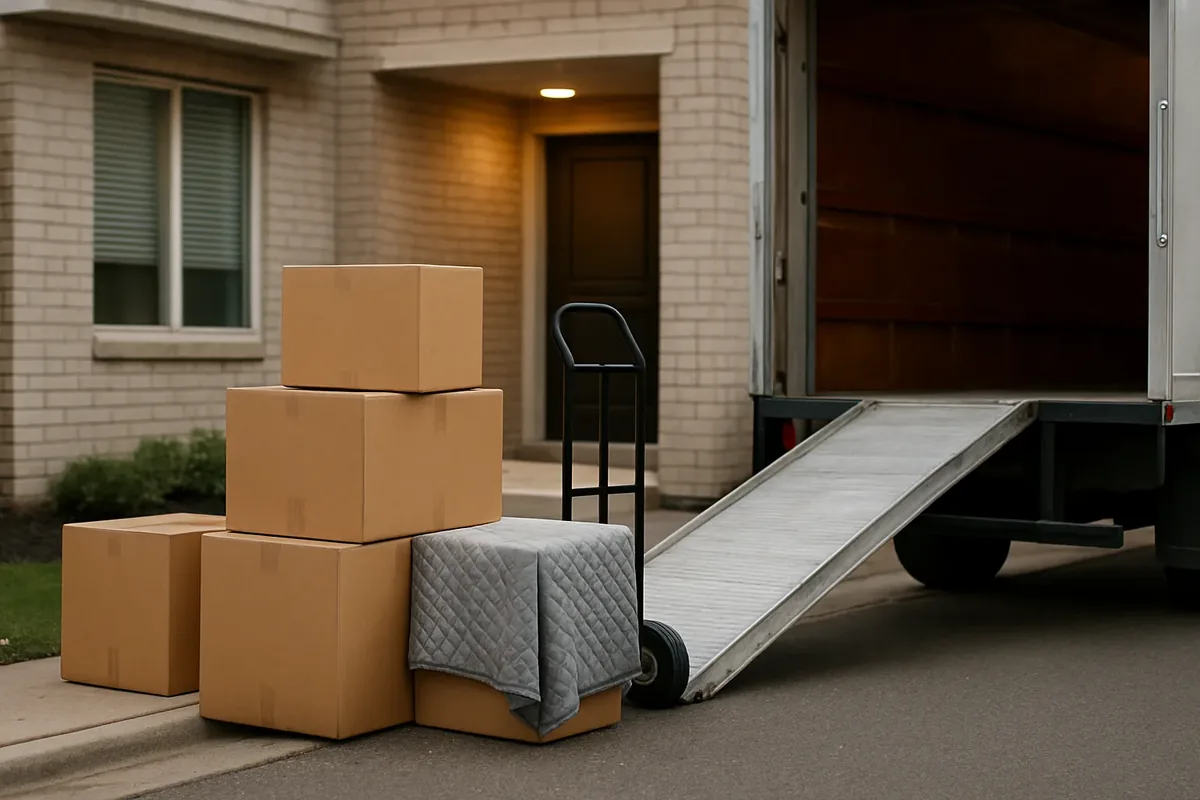
Proper box stacking begins inside your apartment hallway on Day -1 before the moving truck even arrives. Creating pre-sorted vertical stacks keeps corridors clear for senior mobility and lets the Day 0 loading crew slide a 2-wheel hand truck directly under complete 4-box columns.
- Build Tier 1 (Floor Base) With Dense 1.5 Cu Ft Book Boxes. Place 35- to 40-lb small book boxes and rigid 48-ECT double-wall dish packs directly on the hardwood floor or moving truck deck; never place fragile lamps or light large boxes on the bottom tier.
- Build Tier 2 & 3 (Mid-Stack) With Uniform 3.0 Cu Ft Medium Cartons. Stack medium boxes (25–35 lbs each) squarely corner-to-corner over the floor base—aligning vertical corners transfers load through the box walls rather than crushing the soft center lid.
- Cap Tier 4 (Top Load) With Large Bedding Boxes & Cushioned Art. Reserve the top of every hallway stack and truck tier for lightweight 20x20x15-inch linen, pillow, and lampshade cartons (under 20 lbs) plus clearly red-marked fragile glassware boxes.
- Keep Walkways 36 Inches Wide & Quarantine Open-First Cartons. Maintain an unobstructed 36-inch corridor to the front door and bathroom on Day -1 night, and group all red-coded Open-First cartons in one corner so movers load them at the very rear of the truck.
Ready to pair professional packing technique with an accurate move budget? Estimate full white-glove crew labor, material kits, and stair or elevator surcharges in our Apartment Moving Cost Calculator or Movers vs. DIY Rental Truck Comparator.
Open Calculator →Frequently Asked Questions
Should I write detailed item inventories on the outside of every moving box?+
Write broad room and category labels (e.g., "OFFICE — DESK SUPPLIES" or "KITCHEN — GLASSWARE") rather than advertising high-value brands like "ROLEX WATCHES" or "MACBOOK PRO" on exterior cardboard. For senior moves or insurance records, number each carton (#1 to #55) and keep the detailed item-by-number list in a spreadsheet or notebook in your handbag.
Why do movers insist on labeling two adjacent sides instead of just one side and the top?+
Inside a tightly loaded 15-ft to 26-ft box truck or along an apartment staging wall, boxes sit stacked four high and flush against adjacent rows. Marking two adjacent vertical sides (one narrow end, one wide side) guarantees at least one room label and color sticker stays visible no matter how the box is rotated on a hand truck.
Is 2.83-inch extra-wide tape necessary for every box, or only heavy cartons?+
Standard 1.88-inch 3.0-mil commercial tape is plenty strong for regular small and medium boxes when applied in a full H-tape pattern. Upgrading to 2.83-inch 3.4-mil extra-wide tape pays off specifically on heavy 48-ECT dish packs, 24-inch wardrobe boxes, and oversized mirror cartons where narrow tape can miss slightly misaligned center seams.
How should I label furniture pieces whose screws and bolts were removed?+
Place all bolts, Allen keys, and shelf pegs inside a heavy zip-top bag, write the furniture name (e.g., "PRIMARY KING BED RAILS") in bold permanent marker on the bag, and tape the bag directly to the underside of the headboard or inside a dedicated Red-labeled Hardware Box that stays with the move foreman.
Can I use colored painter's tape instead of stickers for room color-coding?+
Yes—brightly colored 2-inch painter's tape or duct tape strips work excellently on corrugated cardboard and will not peel off apartment doorframes when marking destination rooms. Avoid putting duct tape directly onto finished wooden furniture or painted walls; use removable low-tack painter's tape on doorway frames only.
Interactive US Moving Tools
Compare Full-Service Movers vs. DIY Rental Truck in 30 seconds
Related Guides
packing labor and material cost guides
Packing Service & Supply Cost Calculators: Complete US Benchmarks & Guides
Comparing full-service mover packing rates against buying your own boxes, tape, clean newsprint, bubble wrap, blankets, and mattress bags reveals savings of $115 to $1,140+ depending on apartment size. This pillar hub breaks down exact box counts, crew packing hours, fragile-only kitchen packages, and 32-ECT corrugated material specs from studio to 4-bedroom apartments.
packing labor and material cost guides
Mover Packing Service Cost for a Full Studio Apartment (350–550 Sq Ft)
Understand exactly how US moving companies bill hourly packer labor, travel fees, and per-box supply charges for a 350–550 sq ft studio apartment. Compare full-service packing invoices against DIY rental truck budgets and learn where renters can trim $200 to $500 without sacrificing fragile-item protection.

packing labor and material cost guides
DIY Amazon Supply Cost vs. Mover Quote for a Full Studio Apartment (350–550 Sq Ft)
See the line-by-line dollar markup US moving companies apply to boxes, newsprint, bubble wrap, mattress bags, and packing tape for a 350–550 sq ft studio. Learn how much renters keep by sourcing standardized 32-ECT kits online before move day.
packing labor and material cost guides
Exact Box Sizes, Tape & Paper Count for a Full Studio Apartment (350–550 Sq Ft)
Use this room-zone supply blueprint to order the exact count of small, medium, large, dish-pack, and wardrobe cartons plus tape rolls and newsprint pounds for a 350–550 sq ft studio. Avoid mid-pack store runs and overpaying for leftover cardboard.