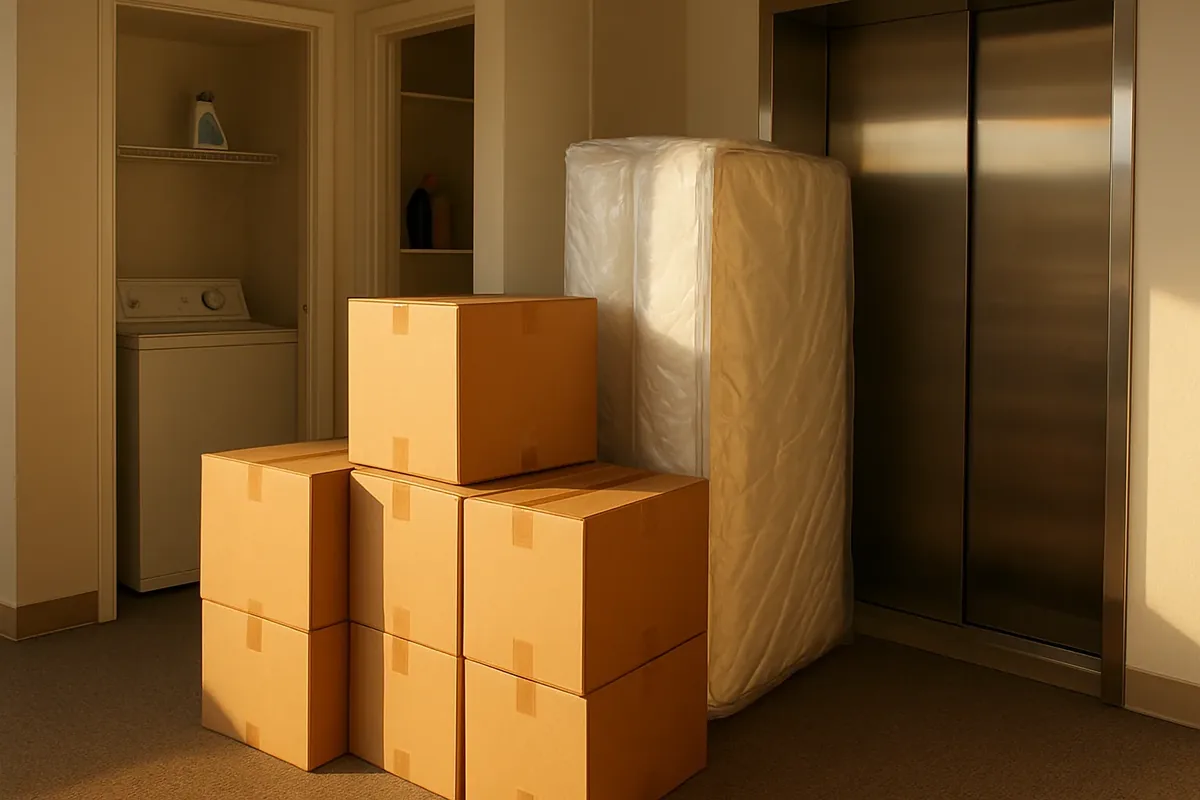
In this guide
Why Laundry Closet Cartons Fail Inside Moving Trucks
When a box splits open on an apartment stairwell or collapses halfway down the interstate, the culprit is rarely the cardboard grade alone—it is empty internal air space combined with weak center-seam taping. Laundry nooks and cleaning closets are notorious for creating half-hollow cartons because their contents have awkward shapes: arched steam-iron handles, angled cordless vacuum heads, curved plastic laundry buckets, spray nozzles, and metal coat hangers.
Inside a 15-ft or 26-ft box truck, crews build floor-to-ceiling tiers up to 7 feet tall. A standard 32-ECT single-wall carton resists vertical compression along its four corner posts—but if there is a 3-inch air gap under the top flaps, the weight of the two boxes stacked above caves the lid inward, bends the sidewalls out of square, and snaps brittle plastic vacuum clips or ceramic soap canisters inside. Eliminating internal voids and orienting rigid items vertically turns an ordinary box into a load-bearing structural column.
| Laundry / Cleaning Item | Orientation & Stacking Rule | Minimum Void-Fill Spec | Target Carton Size | Max Box Weight |
|---|---|---|---|---|
| Steam Irons & Garment Steamers | Vertical soleplate-down on base pad; cord coiled separately | 2-inch crumpled paper base + 1.5-inch side wrap | Small 1.5 cu ft (32-ECT) | 30–35 lbs |
| Cordless Stick & Canister Vacuums | Disassemble wand; motor body centered vertically, dustbin empty | 2-inch bubble/paper wrap on motor + tight corner paper | Medium 3.0 cu ft or Wardrobe | 25–30 lbs |
| Glass Detergent Jars & Ceramic Dispensers | Vertical on edge/base (like dish-pack glasses), never nested bare | 2-inch base cushion + individual paper/bubble sleeves | Small 1.5 cu ft (double-lined) | 30–35 lbs |
| Sealed Dry Pods, Dryer Sheets & Sponges | Flat base layer under lighter textiles; tape flip-top lids shut | 1-inch top buffer to reach flush lid height | Medium 3.0 cu ft (32-ECT) | 25–35 lbs |
| Microfiber Rags, Towels & Mesh Hampers | Compressed tight to act as soft top-layer void fill | None needed (serves as cushion) | Large 3.5–4.5 cu ft or 95L Bag | 20–25 lbs |
| Self-Haul Liquid Cleaners (Car Trunk Only) | Strictly upright; remove cap, add plastic wrap seal, re-tighten | Pack rags between bottles to stop tipping | 36L Moisture-Proof Plastic Tote | 25 lbs max |
The 4 Structural Rules Pro Packers Never Break
- Rule 1: Build a 2-Inch Crumpled Shock Bed First. Before placing a single iron, ceramic canister, or vacuum motor inside a carton, crumple 4 to 6 full sheets of unprinted newsprint into tight baseball-sized domes to form a springy 2-inch bottom layer. Flat folded paper offers almost zero impact absorption when a hand truck drops off a curb or stair riser.
- Rule 2: Apply Vertical Dish-Stacking Geometry to Brittle Parts. Just as pro packers stand dinner plates vertically on edge so downward load travels through the strongest cross-section, stand rigid flat cleaning trays, plastic laundry-sorter dividers, ironing-board sleeve boards, and glass jar bases upright rather than lying flat under heavy stacks.
- Rule 3: Fill Every Corner & Crown the Top 1/2-Inch. Pack heavy items on the bottom, medium items in the middle, and lightweight cleaning cloths, dryer balls, or crumpled paper across the top until the contents sit 1/4- to 1/2-inch proud of the rim before closing flaps. Perform a gentle push test on the sealed lid—if it sinks more than half an inch, reopen and add void fill.
- Rule 4: H-Tape Every Seam with 3.0-Mil Hot-Melt Adhesive. A single strip down the center seam fails whenever a box is lifted by its flaps or rides in a hot truck. Run one continuous strip across the center seam wrapping 3 inches down both sides, then run two perpendicular cross-strips over both outer edges to form a rigid H on the bottom and top.
Amazon US Apartment Moving Supplies
Recommended Moving Boxes, Blankets & Bags for This Move
Apartment moving supplies matched to this guide (Amazon.com affiliate ID: apartmentmovingcost-20).
Duck Brand BladeSafe Foam-Grip 2-Inch Packing Tape Gun Dispenser
Recessed blade safety tape gun with cushioned ergonomic handle and 50-yard starter roll included
Slice 10514 Ceramic-Blade Auto-Retractable Mini Box Cutter (2-Pack)
Finger-friendly zirconium oxide ceramic safety blade that slices box tape without cutting items inside
Scotch Heavy Duty Shipping & Moving Packaging Tape 1.88" x 54.6 yd (6-Roll Pack)
3.0-mil solvent-free hot-melt adhesive tape engineered to lock 80-lb double-wall boxes with a single strip
As an Amazon Associate I earn from qualifying purchases. Always verify live stock and pack sizing directly on Amazon.com.
Tape Guns, Hot-Melt Adhesive & Safe Unpacking Tools
Your tape choice matters just as much as your cardboard ECT rating. Standard 1.8-mil or 2.0-mil discount acrylic tapes often snap mid-pull and lose tack on dusty recycled corrugated liners—a failure that shows up the moment a mover hoists a 35-lb laundry box onto a 3rd-floor walk-up landing.
- High-Shear Hot-Melt Sealing Tape: Scotch Heavy Duty Shipping & Moving Packaging Tape 1.88" x 54.6 yd (6-Roll Pack) uses a 3.0-mil solvent-free hot-melt adhesive engineered to lock up to 80-lb double-wall cartons with a single continuous H-pass. Six rolls deliver 327 total yards—enough for an entire 1-bedroom or 2-bedroom apartment move including the utility closet.
- Ergonomic Recessed-Blade Dispenser: Trying to tear 3.0-mil tape by hand slows packing speed by 30% and leads to crooked seams. A cushioned dispenser like the Duck Brand BladeSafe Foam-Grip 2-Inch Packing Tape Gun Dispenser keeps the cutting teeth recessed until pressed onto the carton, protecting fingers while letting you H-tape a box in 12 seconds.
- Damage-Free Unpacking Cutters: Never jam a long utility knife into a tightly crowned laundry box—steel blades regularly slice through microfiber towels, power cords, and vacuum hoses pressed right beneath the seam. Use a shallow safety cutter like the Slice 10514 Ceramic-Blade Auto-Retractable Mini Box Cutter (2-Pack), whose finger-friendly zirconium oxide ceramic micro-blade slices cleanly through 3.0-mil tape without reaching the gear inside.
Color-Coded Room Labeling That Cuts Unloading Hours
On an hourly local apartment move ($130–$175/hr for 2 movers; $175–$235/hr for 3 movers), disorganized unloading costs real cash. Every time a mover pauses in the hallway asking where an unlabeled box belongs, the clock keeps running—and if your new apartment has a tight 2-hour freight elevator window ($45–$95 staging cost) or 3rd-floor walk-up stairs ($110–$190 surcharge), misrouted boxes create hallway gridlock.
Assign a dedicated color (such as bright green or yellow tape/stickers) strictly to the Laundry Nook & Utility Closet, and label two adjacent vertical sides of every carton—never just the top lid, which disappears the moment boxes are stacked three high. Write three lines in bold marker: the destination zone (`LAUNDRY / UTILITY`), brief contents (`IRON, VACUUM MOTOR, PODS`), and handling priority (`FRAGILE / OPEN DAY 1` for your cleaning essentials).
Truck Stacking Rules: Where Laundry Boxes Belong in the Load
Whether you are loading a DIY 12–15 ft rental truck yourself ($30–$40 daily base plus $1.09–$1.49/mi) or supervising 2-hour loading helpers ($170–$290), follow strict tier physics. Place heavy 1.5 cu ft boxes containing irons, dry hardware, and dense supplies on the lower-middle tier above solid dressers or heavy book cartons. Place medium 3.0 cu ft boxes containing vacuums and brittle plastic caddies on the upper-middle tier marked `TOP LOAD ONLY`, and reserve lightweight 95-liter moving bags of towels and rags for the very top ceiling gap—where they brace the tier against shifting without crushing anything underneath.
Ready to pair pro-grade packing technique with an accurate moving budget? Run your exact apartment size, distance, and stair access through the Apartment Moving Cost Calculator or compare total full-service vs. DIY truck costs in the Movers vs. DIY Rental Truck Comparator.
Open Calculator →Frequently Asked Questions
Should I use biodegradable packing peanuts or crumpled newsprint for laundry appliances?+
Use crumpled unprinted newsprint or 3/16-inch bubble wrap rather than loose packing peanuts for irons, vacuums, and heavy hardware. Heavy items settle straight to the bottom through loose peanuts during truck vibration, whereas tightly crumpled paper and bubble wrap hold heavy appliances centered inside the 2-inch shock zone.
How do movers protect freestanding ironing boards and tall brooms without a box?+
Movers fold the ironing board flat, secure the legs with stretch wrap or rubber bands so they cannot swing open in stairwells, and pad-wrap it in an 85-lb quilted moving blanket. Tall brooms, Swiffers, and mop handles are bundled tightly together with 5-inch stretch film and loaded upright inside a wardrobe carton or strapped vertically along the truck's E-track wall rail.
Does H-taping with 3.0-mil tape really prevent box blowouts on walk-up stairs?+
Yes. Standard 32-ECT boxes almost always fail along the bottom center seam when carried vertically up or down flights of stairs, because hand grip pressure flexes the side flaps outward. H-taping locks the outer perimeter seams to the sidewalls so the bottom flaps cannot separate even under a 40-lb load.
Why shouldn't I write box labels only on the top flaps?+
Once movers stack boxes three or four high on a 2-wheel dolly or inside the truck, top-lid labels are completely hidden. Labeling two adjacent vertical side panels lets the crew read destination rooms at a glance while walking down the hallway, cutting unloading time and avoiding misrouted utility boxes.
If I self-pack using pro cushioning and H-taping rules, will movers insure my boxes against internal breakage?+
Standard FMCSA carrier liability treats any customer-packed box as PBO (Packed By Owner), meaning movers are generally liable only if the outside box is crushed, torn, or dropped—not for unseen internal damage. Following pro 2-inch void-fill, vertical orientation, and 3.0-mil H-taping rules is therefore your primary real-world insurance against breakage.
Interactive US Moving Tools
Compare Full-Service Movers vs. DIY Rental Truck in 30 seconds
Related Guides
packing labor and material cost guides
Packing Service & Supply Cost Calculators: Complete US Benchmarks & Guides
Comparing full-service mover packing rates against buying your own boxes, tape, clean newsprint, bubble wrap, blankets, and mattress bags reveals savings of $115 to $1,140+ depending on apartment size. This pillar hub breaks down exact box counts, crew packing hours, fragile-only kitchen packages, and 32-ECT corrugated material specs from studio to 4-bedroom apartments.
packing labor and material cost guides
Full-Service Packing Price Breakdown: Balcony Closet, Camping & Sports Gear
Break down exactly what US moving companies charge in hourly packer labor, specialty bicycle/golf cartons, heavy-gym surcharges, and pad-wrapping fees for an apartment balcony closet, tool kit, and sporting gear. Compare full-service packing quotes against DIY supply and truck costs.
packing labor and material cost guides
Side-by-Side Material Ledger for Balcony Closet, Camping & Sports Gear
See the exact line-by-line savings between sourcing heavy-duty boxes, cushioning, and tape online versus paying full-service mover truck-stock markups for balcony closets, power tools, and sporting gear. Learn how supply choices also impact hourly loading speed, walk-up stair surcharges, and total apartment move budgets.
packing labor and material cost guides
Supply Shopping List (32 vs 48 ECT) for Balcony Closet, Camping & Sports Gear
Calculate the exact number of small, medium, double-wall 48-ECT, wardrobe, and telescoping specialty boxes plus tape rolls and packing paper needed for an apartment balcony closet, tool stash, and sporting gear. Stop overbuying weak single-wall cartons or running short on moving night.