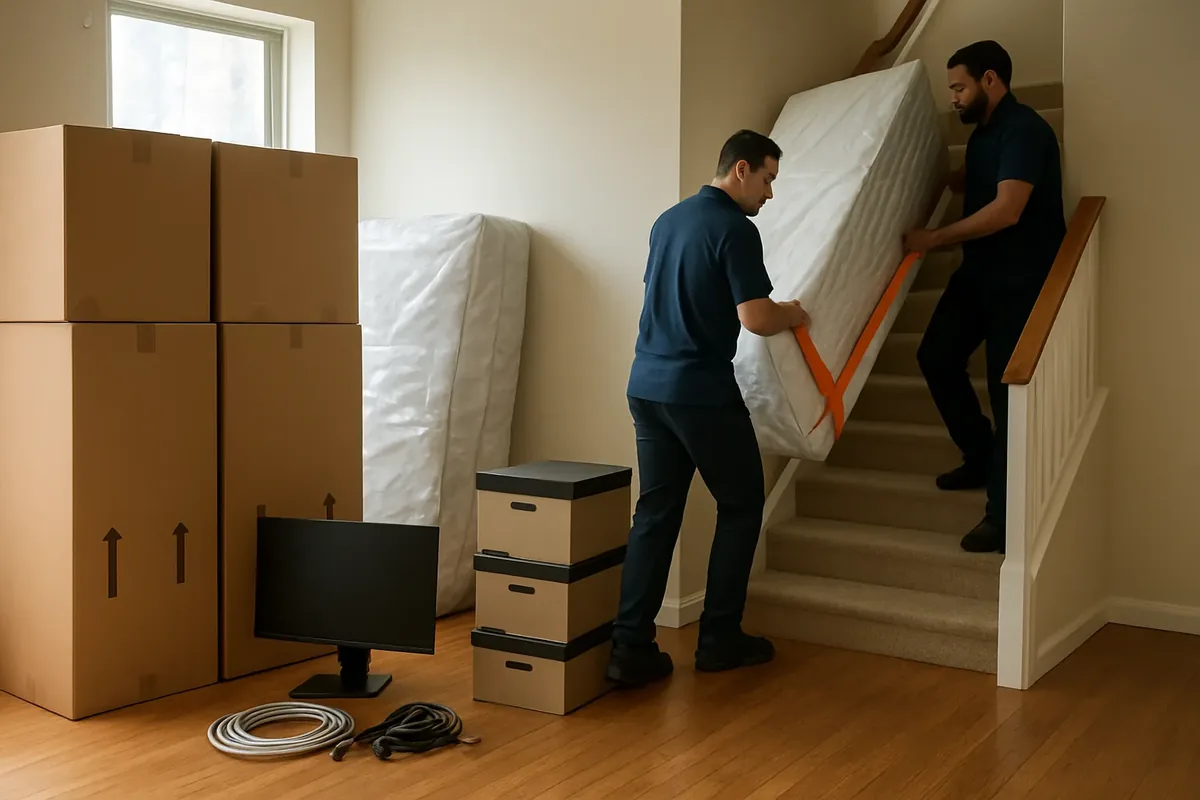
In this guide
The Dish-Pack Physics Behind Safe Home Office Packing
Experienced US van-line packers treat a home office using the exact structural principles built for kitchen dish-packs. Dinner plates break when stacked flat because vertical truck bounce drives the full top load straight through the center of the weakest porcelain disc; stood vertically on edge, each plate transfers shock along its strongest perimeter rim. The identical rule governs 24-inch to 38-inch LCD and OLED monitors, framed diplomas, glass chair mats, and thin mechanical keyboards.
Laying a monitor flat inside a medium box or across the top of a sofa seat exposes the unsupported center of the glass panel to flexing and point impacts whenever a box shifts during highway braking. Standing screens strictly vertical inside a double-wall telescoping carton—buffered by 2 inches of dense void fill beneath, beside, and above the bezel—cuts screen breakage to near zero while allowing movers to slot the carton tightly against a padded truck wall.
Van-Line Cushioning, Weight & Stacking Specifications
Whether you are loading a DIY 12–15 ft rental truck ($30–$40 daily base plus $1.09–$1.49/mi locally) or handing sealed cartons to a 2-mover crew ($130–$175/hr for a 1-bedroom apartment), every home office box must pass the 'shake and press' test: zero internal rattle when shaken and zero lid sag when pressed with two palms. Follow the exact tolerances below.
| Home Office Item | Orientation Rule | Minimum Void Fill / Cushion | Carton Spec & Weight Cap | Truck Tier Placement |
|---|---|---|---|---|
| Flat-Panel Monitors (24"–38") | Strict vertical on edge; screen facing rigid board | Microfiber cover + 1/2" bubble + 2" bottom pad | 48-ECT Telescoping TV/Art Box; max 35 lbs | Vertical against truck wall, strapped to E-track |
| Desktop PC Tower / Workstation | Upright (or motherboard-side down if GPU removed) | Remove heavy GPU; 2" crushed paper on all 6 faces | 48-ECT 20"x20"x20" Double-Wall; max 50 lbs | Bottom tier on flat deck; never under sofas |
| Hanging Files, Tax Binders & Books | Vertical spines down (or flat alternating stacks) | 1" tightly wadded paper to eliminate side shift | 32-ECT Small 1.5 cu ft; strict 35–40 lb cap | Base tier inside truck (load-bearing) |
| Printers, Scanners & Docking Stations | Flat upright (tape scanner lid & remove ink) | 2" crumpled newsprint base + bubble wrap shroud | 48-ECT Double-Wall Cube or Medium; max 45 lbs | Middle tier above dense book/file cartons |
| Desk Lamps, Ceramic Mugs & Glassware | Vertical stem/rim orientation; bulbs removed | Double newsprint wrap + 2" perimeter cushion | 32-ECT Medium (3.0 cu ft); max 25–30 lbs | Upper tier above medium boxes; 'TOP LOAD' |
| Coiled Cables, Power Bricks & Routers | Grouped in zip bags; heavy bricks at box base | Crumpled kraft paper filling every air pocket | 32-ECT Medium (3.0 cu ft); max 35 lbs | Middle tier; mark 'OPEN FIRST — WIFI' |
Amazon US Apartment Moving Supplies
Recommended Moving Boxes, Blankets & Bags for This Move
Apartment moving supplies matched to this guide (Amazon.com affiliate ID: apartmentmovingcost-20).
Color-Coded Apartment Moving Box Labels for 4 Bedrooms & Fragile (600 Stickers)
High-contrast color-coded adhesive labels for Master Bedroom, Bedroom 2, Kitchen, Living Room, Bath, and Fragile
Sharpie Chisel-Tip Permanent King-Size Black & Red Moving Box Markers (4-Pack)
Wide felt chisel-tip permanent ink markers readable from 15 feet away on brown corrugated cardboard
Scotch Heavy Duty Packaging Tape with Individual Red Dispensers (6-Pack)
Six 22.2-yard rolls each pre-loaded on a handheld fall-back-tab dispenser for multi-person packing
As an Amazon Associate I earn from qualifying purchases. Always verify live stock and pack sizing directly on Amazon.com.
The 3-Strip H-Taping Protocol & Why Labeling Cuts Unloading Costs
A single center tape strip down a 32-ECT box leaves the two side seams vulnerable to moisture, dust, and lateral racking on a 3rd-floor walk-up turn. Professional crews H-tape every heavy carton: one center strip overlapping 3 inches down each side wall, plus two perpendicular edge strips locking the open side seams into a rigid 'H' pattern. Doing this on both bottom and top flaps turns a flat-packed carton into a torsion-resistant structural block.
Just as critical is side-wall—never top-only—labeling. Once boxes stack four high inside a truck or freight elevator, top labels vanish. When a 2-mover crew ($130–$175/hr) or 3-mover crew ($175–$235/hr) has to pause and ask 'Where does this box go?' 35 times during unload, you burn 25 to 45 extra minutes ($55–$175) in pure sorting friction.
- High-contrast color-coded adhesive moving labels (such as Savvy & Sorted 3" x 2" Color-Coded Apartment Moving Box Labels, 600-sticker rolls covering bedrooms, kitchen, bath, office, and Fragile): give movers instant visual routing from across the hallway without reading small handwriting.
- Wide 5mm chisel-tip permanent moving markers (such as Sharpie Chisel-Tip Permanent King-Size Black & Red Moving Box Markers, 4-pack): stay legible from 15 feet away on brown corrugated board; use black ink for room/contents and red ink exclusively for 'FRAGILE — VERTICAL ONLY' or 'TOP LOAD'.
- Individual handheld dispenser tape packs (such as Scotch Heavy Duty 3.0-mil Packaging Tape with Individual Red Dispensers, 6-pack of 1.88" x 22.2 yd rolls): let roommates or partners H-tape cartons simultaneously in separate corners of the apartment without sharing a single tape gun.
Cost of Poor Cushioning vs. Proper DIY Specs
Cutting corners on void fill or tape rarely saves more than $15 on supplies, yet a single crushed 27-inch monitor costs $250–$600 to replace—and under standard Released Value Protection (60 cents per pound), a 12-pound monitor pays just $7.20 in carrier claim recovery. Even Full Value Protection typically excludes PBO (Packed By Owner) internal damage when the box lacked proper cushioning.
| Protection Approach | Home Office Material Cost | Whole 1-BR Material Cost | Breakage & Liability Profile |
|---|---|---|---|
| Under-Packed DIY (Grocery Boxes, Thin Tape, No Void Fill) | $10–$20 | $35–$65 | High crush risk; $7.20 max payout on 12-lb monitor at $0.60/lb |
| Pro-Spec DIY (32/48-ECT, 2" Cushion, H-Tape, Labels) | $38–$68 | $95–$160 | Near-zero shift damage; fast crew routing saves 30–45 min unload |
| Full-Service Mover Pack (Crew Boxes & Supplies) | $255–$490 (incl. 1–1.5 hrs labor) | $290–$520 materials + labor | Carrier-packed coverage eligible under Full Value Protection |
5-Step Pro Cushioning & Stacking Checklist
- Build a 2-Inch Crumpled Base Layer. Crush 4 to 6 full sheets of unprinted packing paper into springy loose balls (never flat stacks) across the bottom of every electronics or peripheral box before placing hardware inside.
- Wrap and Isolate Heavy Sub-Components. Remove graphics cards from custom PC towers if moving long distance, detach monitor stands and VESA brackets, and wrap heavy power bricks separately so they cannot hammer against plastic bezels.
- Fill All Side and Top Voids Until Zero Movement. Pack crumpled paper tightly around all four sides and across the top 2 inches so the box flaps meet with slight spring resistance—never bulging upward and never sinking inward when pressed.
- Apply 3-Strip H-Tape and Side Labels on Two Adjacent Faces. Seal top and bottom seams in an H-pattern with 3.0-mil tape, then stick color-coded room labels and bold black/red chisel-marker notes on two adjacent vertical sides so at least one face stays visible in every truck tier.
- Stage in Weight Tiers for Load Crew or Rental Truck. Stack heavy 35-lb file boxes on the floor as base blocks, medium peripheral cartons on top, and lean vertical monitor cartons flat against a wall where no one will set furniture against them.
Put your pro-packed box plan into an accurate move budget—compare full-service crews against a DIY rental truck with our Apartment Moving Cost Calculator and Movers vs. DIY Rental Truck Comparator.
Open Calculator →Frequently Asked Questions
Should I use biodegradable packing peanuts or crumpled newsprint for computer equipment?+
Use crumpled unprinted packing paper or anti-static bubble wrap—never loose starch or foam packing peanuts. Loose peanuts settle to the bottom of a vibrating truck within 20 miles, letting heavy hardware sink straight onto the cardboard base, and static-charged foam beads cling to cooling fans and open USB ports.
How does FMCSA valuation cover monitors if I pack them myself versus having movers pack them?+
Federal FMCSA interstate regulations require movers to offer Released Value Protection ($0.60/lb per article at no extra charge) and Full Value Protection (repair, replacement, or cash settlement, subject to a deductible). However, movers mark self-packed cartons 'PBO' and generally deny internal breakage claims unless the outside box shows visible crushing from crew mishandling. For $1,000+ OLED monitors, either pay the crew to box that single item or haul it in your personal car.
What weight limit should I enforce on office boxes for a 3rd- or 4th-floor walk-up?+
Keep every box strictly under 35 lbs in walk-up buildings. A 3rd-floor walk-up already adds 1.0–1.75 extra crew hours ($110–$190) and a 4th- or 5th-floor walk-up adds 1.75–3.0 hours ($185–$340). Overweight 55-lb file boxes force movers to carry one carton at a time instead of stacking two on a hand truck or shoulder carry, stretching billable stair time.
How should I stack home office boxes inside a 10-ft or 15-ft DIY rental truck?+
Load heavy 32-ECT small file boxes flat along the front cab wall as a solid base tier, stack lighter peripheral and lamp boxes above them up to shoulder height, and strap vertical flat-panel monitor cartons between a mattress (sealed in a 5-mil plastic mattress bag) and padded desk surfaces using cargo tie-downs so nothing leans or shifts around corners.
Do high-rise buildings require extra floor or wall protection when wheeling heavy office boxes?+
Yes—most urban high-rises requiring a Certificate of Insurance (COI) and reserved freight elevator (adding 0.5–1.0 hour or $45–$95) mandate Masonite floor runners in carpeted hallways and padded elevator wall blankets. Licensed movers supply these protections as part of COI compliance; DIY movers must ask building management whether rolling 4-wheel dollies require non-marking rubber casters.
Interactive US Moving Tools
Compare Full-Service Movers vs. DIY Rental Truck in 30 seconds
Related Guides
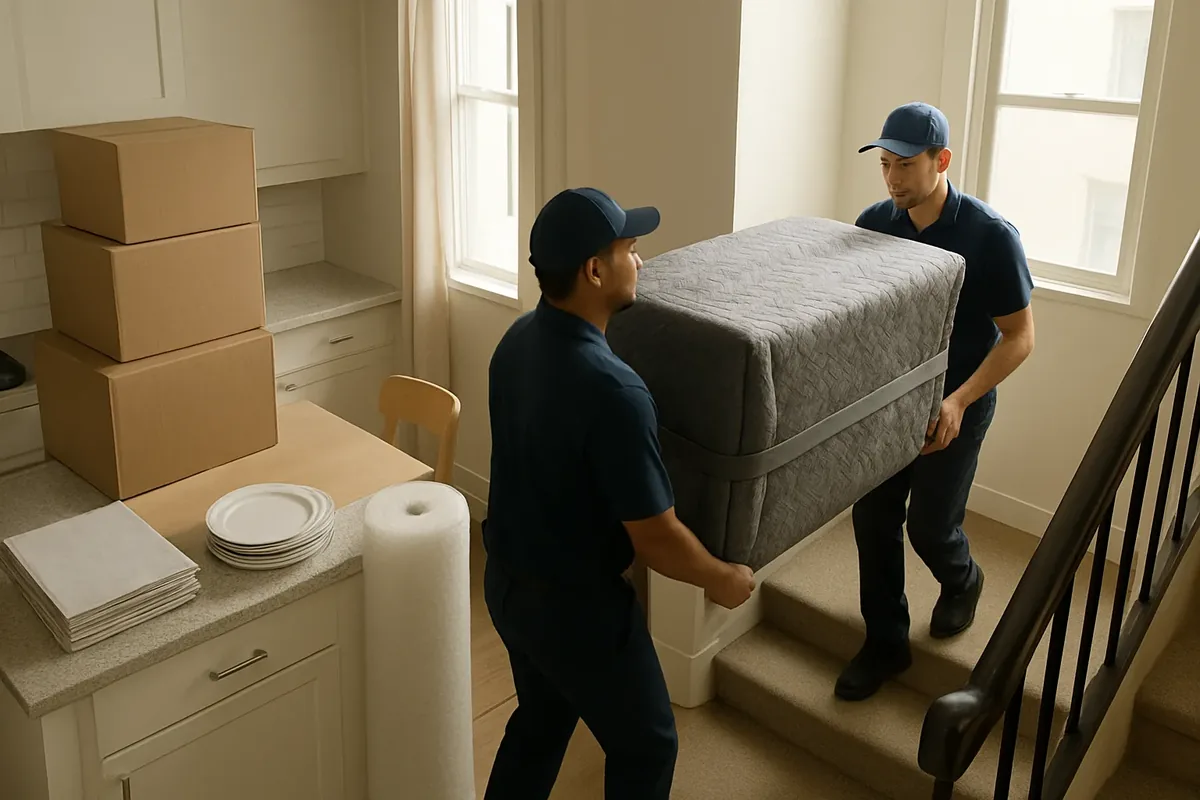
packing labor and material cost guides
Packing Service & Supply Cost Calculators: Complete US Benchmarks & Guides
Comparing full-service mover packing rates against buying your own boxes, tape, clean newsprint, bubble wrap, blankets, and mattress bags reveals savings of $115 to $1,140+ depending on apartment size. This pillar hub breaks down exact box counts, crew packing hours, fragile-only kitchen packages, and 32-ECT corrugated material specs from studio to 4-bedroom apartments.
packing labor and material cost guides
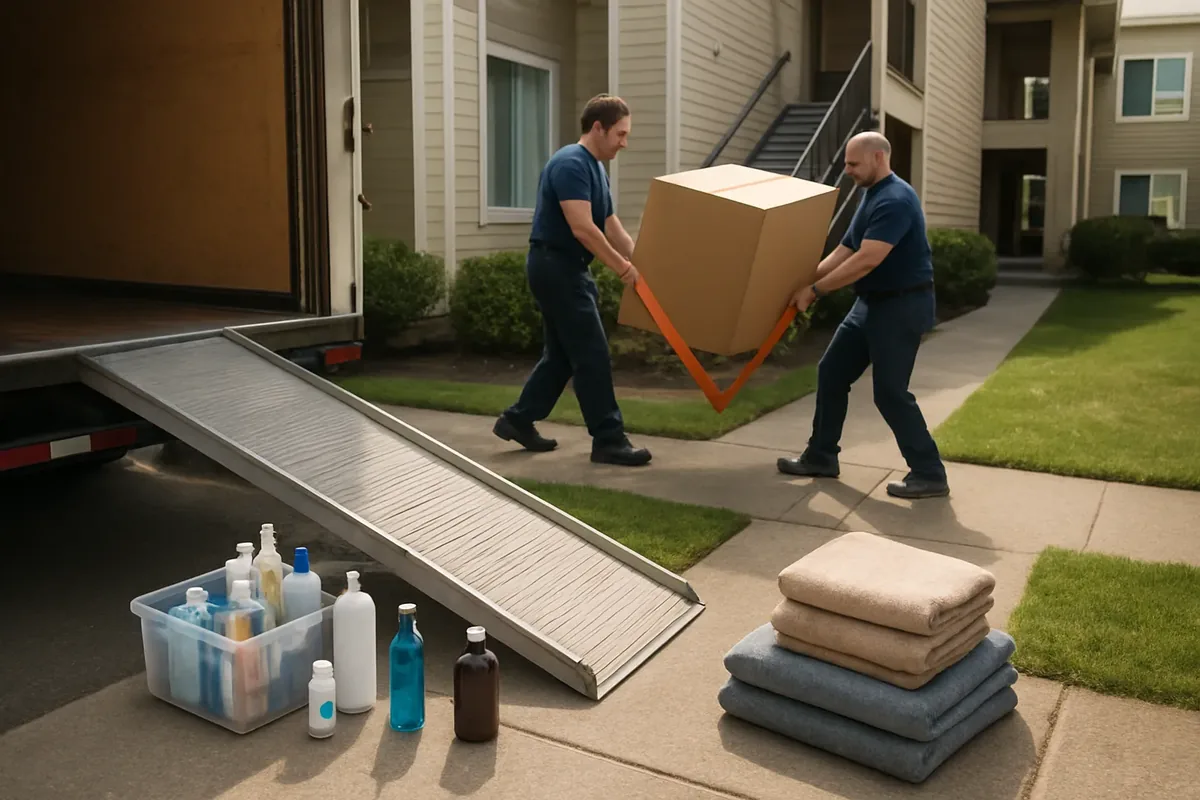
Full-Service Packing Price Breakdown: Bathroom Cabinets, Liquids & Linen Closet
Bathrooms are the smallest rooms in a US apartment yet generate surprising packing invoices because crews individually wrap glass skincare jars, bag opened bottles, and box dense linen closets at hourly rates. Here is what moving companies actually charge—and which bathroom items crews legally refuse to pack.

packing labor and material cost guides
Side-by-Side Material Ledger for Bathroom Cabinets, Liquids & Linen Closet
Paying moving-company tariff prices for bathroom boxes, packing tape, and wrapping paper routinely triples your material bill compared to buying a self-pack kit online. Use this line-by-line dollar ledger to compare DIY supply costs against mover markups across bathroom cabinets, liquids, and linen closets.

packing labor and material cost guides
Supply Shopping List (32 vs 48 ECT) for Bathroom Cabinets, Liquids & Linen Closet
Calculate the exact number of small, medium, large, dish-pack, and wardrobe cartons plus tape rolls and packing paper pounds needed for US apartment bathrooms and linen closets. Learn where 32-ECT single-wall boxes save money and where 48-ECT double-wall cartons prevent liquid leaks and crush failures.