In this guide
- Why Self-Packed 1-Bedroom Boxes Fail in Transit (Even on Short Moves)
- The 7 Packing Mistakes That Break Items—and the Exact Fix
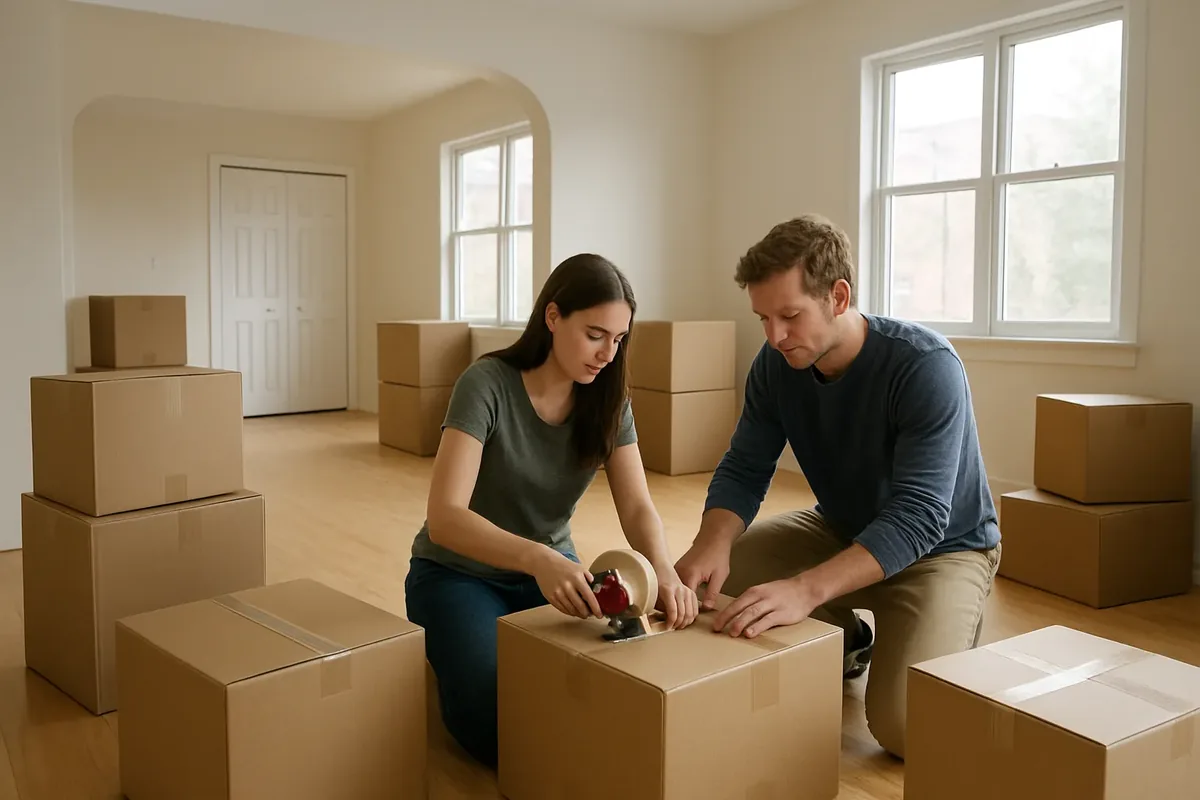
- Mastering the H-Tape Seam Method Step by Step
- Vertical Plate Stacking & 2-Inch Void Cushioning Rules
- Color-Coded Room Labels & Truck Tiering Inside a 12–15 Ft Box Truck
- How Proper Packing Lowers Both Labor Time and Breakage Risk
Why Self-Packed 1-Bedroom Boxes Fail in Transit (Even on Short Moves)
Most apartment renters assume breakage only happens on 1,800-mile cross-country hauls. In reality, local moves under 15 miles inside a 12-to-15-foot rental truck or moving van produce sharp vertical shock every time a truck crosses city potholes, climbs a loading ramp, or brakes at a traffic light. Because boxes in a 420-cubic-foot 1-bedroom load are stacked four to five tiers high, a single crushed carton at the bottom of a column can topple $800 worth of kitchenware and monitors in one turn.
Worse, under federal FMCSA and state moving tariffs, any carton marked PBO (Packed By Owner) carries zero carrier coverage for internal breakage unless the exterior cardboard shows obvious puncture or forklift damage. Following commercial H-taping, vertical loading, and 2-inch cushioning rules lets you capture the full $195–$360 DIY supply savings ($95–$160 DIY vs. $290–$520 mover supplies) with commercial-grade protection.
The 7 Packing Mistakes That Break Items—and the Exact Fix
Audit every carton you pack across your 600–850 sq ft apartment against these seven structural failure points before sealing the top flaps.
| Common DIY Mistake | Why It Breaks Items | Pro Relocation Standard | Target Zone in 1BR Unit |
|---|---|---|---|
| 1. Stacking dinner plates flat | Vertical road shock concentrates full stack weight onto bottom plate rim | Wrap individually in 2 sheets newsprint; stand vertically on edge | Kitchen dish & small cartons |
| 2. Interlocking flaps or single-strip tape | Interlocked flaps buckle downward; single strips split under 30+ lbs | Fold straight and apply full 3-strip H-tape method top & bottom | All 37 cartons (especially 12 small) |
| 3. Leaving empty headroom at top of box | Upper truck tiers crush hollow lid, collapsing sidewalls inward | Fill all remaining voids flush with crumpled paper or starch peanuts | Medium & large boxes |
| 4. Zero bottom or perimeter buffer | Floor drops transmit impact directly into ceramic or glass edges | Build a 2-inch compressed cushion bed on bottom, sides, and top | Glassware, electronics, decor |
| 5. Packing heavy books in medium/large boxes | Carton hits 65–80 lbs, tearing handles and straining stair carriers | Restrict dense loads to 1.5 cu ft small boxes; cap weight <=40 lbs | Bookshelves, pantry cans, vinyl |
| 6. Labeling only the top flaps | Once stacked 4-high in truck or hallway, room labels vanish | Apply color-coded room labels on two adjacent side panels | Every sealed carton |
| 7. Deep-blade utility knife unpacking | Long razor blades slice upholstery, coats, and power cords beneath tape | Use an auto-retractable micro-ceramic safety cutter on unpacking day | Wardrobe, linen & media cartons |
Amazon US Apartment Moving Supplies
Recommended Moving Boxes, Blankets & Bags for This Move
Apartment moving supplies matched to this guide (Amazon.com affiliate ID: apartmentmovingcost-20).
Biodegradable Cornstarch Anti-Static Loose Fill Packing Peanuts (7 Cubic Feet)
Static-free water-soluble void-fill peanuts for stabilizing odd-shaped electronics and vases inside cartons
Duck Brand BladeSafe Foam-Grip 2-Inch Packing Tape Gun Dispenser
Recessed blade safety tape gun with cushioned ergonomic handle and 50-yard starter roll included
Slice 10514 Ceramic-Blade Auto-Retractable Mini Box Cutter (2-Pack)
Finger-friendly zirconium oxide ceramic safety blade that slices box tape without cutting items inside
As an Amazon Associate I earn from qualifying purchases. Always verify live stock and pack sizing directly on Amazon.com.
Mastering the H-Tape Seam Method Step by Step
Interlocking four box flaps without tape—the 'pinwheel fold'—creates a false sense of security that fails the moment a mover lifts the carton by its side grips on a 3rd-floor walk-up. Commercial movers rely exclusively on the H-tape method because it locks both the center seam and the structural side edges against shearing force.
- Square the carton and fold short flaps first. Press the two minor (short) flaps inward at a crisp 90-degree angle, then fold the two major (long) flaps flat until they meet cleanly down the center line without overlapping.
- Run the primary center seam strip with 3-inch overhangs. Pull one continuous strip of 2-inch acrylic tape across the entire center seam, extending at least 3 inches down both vertical end walls so the corners cannot peel open.
- Add two perpendicular edge strips to form the 'H'. Apply two perpendicular strips across the outer edges where the major flaps meet the side walls. On heavy book or dish boxes (30–45 lbs), run a second overlapping pass down the bottom center seam.
- Burnish the adhesive with palm pressure. Acrylic moving tape is pressure-sensitive—rubbing firmly along all three tape lines activates the bond into recycled kraft fibers, preventing cold-morning or humid-stairwell pop-offs.
Vertical Plate Stacking & 2-Inch Void Cushioning Rules
Ceramics and tempered glass withstand tremendous compression along their edge arc—just like an arch bridge—but shatter under minor flexing across their flat face. Never lay wrapped dinner plates horizontally like they sit in your kitchen cabinet. Instead, lay a 2-inch bed of tightly crumpled unprinted newsprint or anti-static starch peanuts across the bottom of a small or double-wall dish carton. Wrap each plate in two sheets of 24"x36" paper, bundle three wrapped plates together with an extra outer sheet, and stand the bundles vertically on edge.
Next, nest stemmed wine glasses or mugs upright (rim up or rim down, never sideways) in the upper tier separated by a rigid cardboard divider sheet or 2 inches of dense paper buffer. Before H-taping the top lid, press down gently with both palms: the lid should sit completely flat with slight upward spring resistance. If the top dips inward even half an inch, add crumpled paper or loose-fill peanuts until zero rattle remains when you gently shake the sealed box.
Color-Coded Room Labels & Truck Tiering Inside a 12–15 Ft Box Truck
Good packing ends with smart stacking. Whether you hire a 2-mover crew ($130–$175/hr, 4.0–6.0 base hours + 1.0 travel hour) or rent a 12–15 ft DIY truck ($30–$40/day plus $1.09–$1.49/mi local), box placement dictates unload speed and damage risk:
- Assign four unmistakable room colors: Use bright colored tape or stickers on two adjacent side walls—for example, Yellow for Kitchen, Blue for Bedroom, Green for Living Room, and Red for Fragile / Open First. Movers walking off a freight elevator spot a blue side tag in half a second without asking where the box belongs.
- Build heavy-to-light weight tiers in the truck: Place 1.5 cu ft small boxes (books, cans, dense kitchenware) and 48-ECT dish cartons on the floor tier against the front bulkhead wall. Stack medium 3.0 cu ft boxes on tier two and three, and reserve the top ceiling tier strictly for lightweight 4.5 cu ft large boxes (pillows, bedding, lampshades).
- Never place soft bags or odd-shaped lamps beneath rigid cartons: Soft items shift under braking and collapse the entire vertical column above them.
- Keep a 2-inch clearance from unwrapped metal rails: Pad wood dressers and bed frames with 85-lb quilted moving blankets and secure vertical tiers with ratchet straps tied into the truck's wooden rub rails.
How Proper Packing Lowers Both Labor Time and Breakage Risk
Well-cushioned, flat-topped, color-labeled boxes save real cash on move day. When a 2-mover crew sees uniform, firm 32-ECT and 48-ECT cartons stacked cleanly in a living room staging zone, they roll four boxes at a time on a 2-wheel appliance dolly—shaving 30 to 60 minutes ($65–$175) off unloading and placement compared to fragile, sagging cartons that must be hand-carried one by one down walk-up stairs (where 2nd-to-5th floor surcharges already run $55–$340). Spend twenty extra seconds per box H-taping and filling top voids, and your entire 1-bedroom apartment arrives intact.
Planning your full 1-bedroom apartment move budget alongside your packing supply list? Run your exact stair flights, distance, and crew options in the Apartment Moving Cost Calculator or compare DIY truck totals in our Movers vs. DIY Rental Truck Comparator.
Open Calculator →Frequently Asked Questions
Does H-taping really prevent bottom blowouts better than heavy-duty tape down the center seam?+
Yes. A single center strip resists outward pull only along the middle line, leaving the four corner edges vulnerable to flexing and tearing when boxes are carried down apartment stairs or gripped by side handholds. Adding the two perpendicular edge strips locks the entire bottom panel into a rigid diaphragm, even on recycled corrugated cardboard.
Are biodegradable cornstarch packing peanuts safe around electronics and laptops?+
Yes—unlike traditional polystyrene foam peanuts that build static charges and cling to circuit vents, starch-based loose fill is naturally anti-static. Still, always wrap bare monitors, routers, or game consoles in a clean polyethylene sleeve or microfiber cloth first so fine starch dust never enters cooling fans.
If a mover drops a box I packed myself, does basic valuation cover the broken dishes?+
Under standard FMCSA Released Value Protection ($0.60 per pound per article), movers only pay for internal breakage in a PBO (Packed By Owner) carton if there is clear proof of carrier negligence, such as a visibly crushed or punctured box exterior. Even under Full Value Protection, improper DIY cushioning (like flat-stacked plates with no void fill) typically disqualifies a claim.
How heavy is too heavy for a moving box in a 3rd-floor walk-up apartment?+
Cap every box at 35 to 40 pounds in a walk-up apartment, and never exceed 45 pounds even in a ground-floor or elevator building. Overweight boxes slow movers down—worsening the 1.0–1.75 extra hours and $110–$190 surcharge typical of a 3rd-floor walk-up—and dramatically increase the odds of dropped cartons on narrow landings.
Can I use newspaper instead of unprinted newsprint packing paper to save money?+
Avoid printed newspapers for dishes, white stoneware, matte ceramics, and linens. Modern soy-based newspaper inks rub off immediately onto porous ceramic glaze and damp hands, forcing you to rewash every item in your new kitchen. A 20-to-25-pound bundle of clean unprinted 24"x36" newsprint eliminates ink transfer completely.
Interactive US Moving Tools
Compare Full-Service Movers vs. DIY Rental Truck in 30 seconds
Related Guides
packing labor and material cost guides
Packing Service & Supply Cost Calculators: Complete US Benchmarks & Guides
Comparing full-service mover packing rates against buying your own boxes, tape, clean newsprint, bubble wrap, blankets, and mattress bags reveals savings of $115 to $1,140+ depending on apartment size. This pillar hub breaks down exact box counts, crew packing hours, fragile-only kitchen packages, and 32-ECT corrugated material specs from studio to 4-bedroom apartments.
packing labor and material cost guides
Professional Packing Labor & Material Quote: Full 2-Bedroom Apartment (900–1,250 Sq Ft)
See exactly what licensed US moving companies charge in 3-person crew hourly rates and per-carton material tariffs to pack a 900–1,250 sq ft 2-bedroom apartment. Compare full-pack, partial fragile-pack, and pure DIY totals side by side.
packing labor and material cost guides
Mover Box Markup vs. Buying Your Own Kit: Full 2-Bedroom Apartment (900–1,250 Sq Ft)
Review a complete line-by-line self-pack supply ledger for a 900–1,250 sq ft 2-bedroom apartment comparing retail DIY carton and tape budgets against mover tariff markups. See where you capture $315 to $585 in pure materials savings.
packing labor and material cost guides
Complete Carton & Cushioning Calculator: Full 2-Bedroom Apartment (900–1,250 Sq Ft)
Get the exact room-by-room count of 32 ECT standard cartons, 48 ECT double-wall dish packs, wardrobe boxes, tape rolls, and packing paper pounds required for a 900 to 1,250 sq ft two-bedroom apartment. Compare DIY material bundles against mover-supplied carton tariffs before moving day.