
In this guide
- What Is a Warehouse Handling-In and Handling-Out Vault Fee?
- How SIT Warehouse Handling Compares: Full-Service Movers vs. DIY Rental Truck
- FMCSA Interstate SIT Rules, State Tariff Caps, and the 180-Day Conversion Limit
- Apartment Building COI, Freight Elevator, and Access Fee Interactions
- Protecting Soft Goods and Cartons During Vault Stacking
What Is a Warehouse Handling-In and Handling-Out Vault Fee?
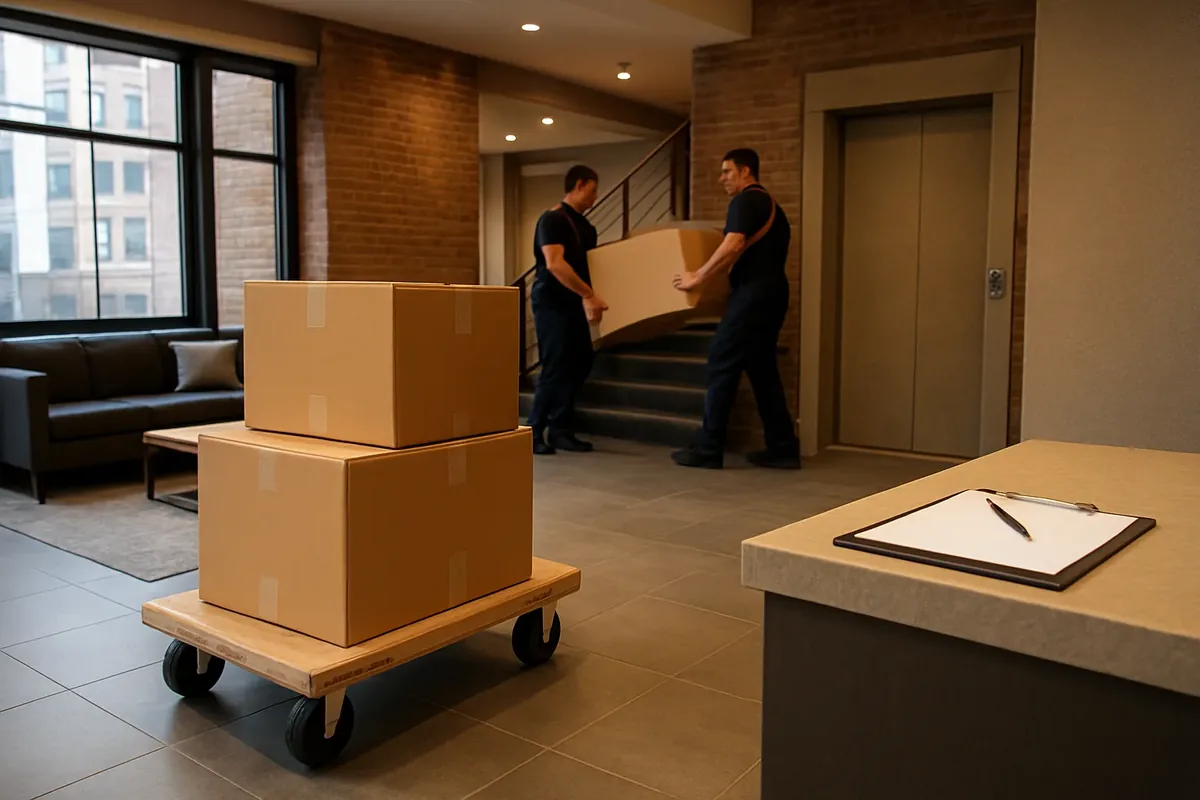
When your outgoing apartment lease ends on the 31st and your new lease does not start until the 10th, full-service carriers bridge that gap with Storage-in-Transit (SIT). Unlike renting a drive-up self-storage locker where you hold the key, carrier SIT places your household goods inside a secured palletized moving warehouse using standard 5 ft x 7 ft x 7 ft wooden vaults (roughly 200 to 245 usable cu ft, holding 1,000 to 1,250 lb per vault). Because a warehouse crew must physically unload the linehaul or local truck, blanket-pad and stack your items inside numbered vaults, forklift those vaults into vertical racks, and later pull and reload them onto a delivery truck, the carrier charges a separate warehouse handling-in and handling-out fee—often billed simply as Warehouse Handling or SIT First-Day Handling.
Under interstate household goods tariffs modeled on the historical 400N rate structure, the warehouse handling fee is a one-time accessorial charge assessed per hundredweight (cwt, or per 100 lb) of your shipment's scaled weight, or per vault on local flat-rate schedules. Crucially, the single tariff line item labeled Warehouse Handling is meant to cover both handling-in (truck to vault) and handling-out (vault to delivery truck). It does NOT include the separate Delivery Out of SIT transportation fee, which pays for the driver, truck, and crew to haul your furniture from the warehouse to your new apartment building.
How SIT Warehouse Handling Compares: Full-Service Movers vs. DIY Rental Truck
Renters often assume adding two weeks of carrier storage only costs the monthly vault rent ($65–$115 per vault per month). In practice, the warehouse handling fee plus the second-leg Delivery Out of SIT labor easily doubles the cost of a local move. On local moves under 15 miles, standard base labor runs $130–$175/hr for a 2-person crew (4.0–6.0 hrs plus a 1.0-hr travel fee) for a 1-bedroom apartment, and $175–$235/hr for a 3-person crew (5.0–7.5 hrs plus 1.0-hr travel) for a 2-bedroom unit. Adding SIT means paying full origin labor, warehouse handling in/out, daily or monthly vault storage, and a second full redelivery leg—complete with a second 1-hour travel fee and a second building COI issuance.
| Apartment Size (Cu Ft / Weight) | Origin & Delivery Mover Labor + Transport | Warehouse Handling In/Out + 30-Day Vaults | Packing Materials (Mover vs. DIY) | Total Full-Service SIT vs. DIY Rental + Self-Storage |
|---|---|---|---|---|
| Studio (250 cu ft / 2,000 lb) | $1,050–$1,690 (2 crew, 2 legs + travel) | $260–$480 (2 vaults handling + 1 mo) | $180–$320 mover / $65–$110 DIY | $1,490–$2,490 SIT vs. $340–$680 DIY (10-ft truck x 2) |
| 1-Bedroom (420 cu ft / 3,200 lb) | $1,450–$2,540 (2 crew, 2 legs + travel) | $390–$730 (3 vaults handling + 1 mo) | $290–$520 mover / $95–$160 DIY | $2,130–$3,790 SIT vs. $480–$940 DIY (12–15 ft truck x 2) |
| 2-Bedroom (680 cu ft / 5,400 lb) | $2,250–$3,990 (3 crew, 2 legs + travel) | $620–$1,140 (4–5 vaults handling + 1 mo) | $460–$820 mover / $145–$235 DIY | $3,330–$5,950 SIT vs. $720–$1,390 DIY (15–20 ft truck x 2) |
| 3-Bedroom (980 cu ft / 7,800 lb) | $3,450–$5,880 (4 crew, 2 legs + travel) | $890–$1,620 (6–7 vaults handling + 1 mo) | $680–$1,180 mover / $205–$330 DIY | $5,020–$8,680 SIT vs. $1,080–$1,980 DIY (20–26 ft truck x 2) |
| 4BR / Loft (1,280 cu ft / 10,200 lb) | $4,720–$7,950 (4 crew, 2 legs + travel) | $1,150–$2,090 (8–9 vaults handling + 1 mo) | $920–$1,560 mover / $265–$420 DIY | $6,790–$11,600 SIT vs. $1,420–$2,590 DIY (26-ft truck x 2) |
The DIY column above factors in two separate 1-day rental truck reservations (move-out and move-in), daily base rates ($20–$30 for a 10-ft truck up to $60–$85 for a 26-ft truck), local mileage ($0.99–$1.79/mi), fuel at $3.55/gal at 10 mpg, one month of climate-controlled self-storage ($110–$340 depending on unit size), and DIY packing supplies. If you hire 2-hour DIY loading helpers ($170–$290 per leg) for heavy furniture, you still frequently beat full-service SIT warehouse costs by 45% to 60% on local lease gaps.
Amazon US Apartment Moving Supplies
Recommended Moving Boxes, Blankets & Bags for This Move
Apartment moving supplies matched to this guide (Amazon.com affiliate ID: apartmentmovingcost-20).
Duck EZ Start Frustration-Free Quiet Packaging Tape (6-Roll Pack)
Smooth whisper-quiet unrolling adhesive tape ideal for late-night apartment packing without loud screeching
Heavy-Duty Reusable Tarp Mattress Moving Bag with 8 Handles & Zipper (King)
Tear-proof woven tarp King mattress bag allowing 2 people to steer a floppy memory-foam mattress down tight turns
4-Mil Heavy-Duty Clear Twin & Full Mattress Moving & Storage Bag (2-Pack)
Tear-resistant 4-mil clear polyethylene sleeves sized for Twin, Twin-XL, and Full studio or guest beds
As an Amazon Associate I earn from qualifying purchases. Always verify live stock and pack sizing directly on Amazon.com.
FMCSA Interstate SIT Rules, State Tariff Caps, and the 180-Day Conversion Limit
Federal rules under 49 CFR Part 375 govern interstate moves—including SIT ordered as part of an interstate shipment. Under federal regulations, SIT is strictly a temporary transit extension capped at 180 calendar days (some carrier tariffs cap initial SIT at 90 days unless extended in writing before day 90). While your apartment belongings sit in SIT, the interstate carrier remains legally liable under the Bill of Lading valuation you selected (either Released Value at $0.60/lb or Full Value Protection) and must honor the published tariff rates for warehouse handling and daily SIT storage.
- 180-Day Permanent Storage Conversion: If your goods remain in the warehouse past day 180 (or the tariff's SIT limit), the interstate Bill of Lading terminates. Your account converts to Permanent Storage governed by state warehouseman's lien statutes, carrier FVP coverage typically lapses unless you buy separate warehouse insurance, and local redelivery rates replace interstate tariff pricing.
- 110% Non-Binding Collection Cap Does Not Waive Post-Contract SIT: On an interstate non-binding estimate, a mover can demand no more than 110% of the estimate at delivery—but if you request SIT after the truck is loaded because your new apartment elevator reservation fell through, SIT handling, daily storage, and redelivery become legitimate post-contract additive services billed separately.
- California & Regulated Intrastate Tariffs: In states with active household goods regulators—such as California's Bureau of Household Goods and Services (BHGS) MAX 4 tariff, New York DOT, or Illinois Commerce Commission—warehouse handling-in/out rates, minimum SIT weight floors (often 1,000 to 2,000 lb), and Double Drive Time (DDT) billing rules on the delivery-out leg are strictly capped by published state schedules.
- Valuation Surcharge on SIT: If you purchased Full Value Protection ($6/lb minimum valuation), carriers legally assess an additional SIT valuation surcharge—usually 10% to 15% of the base FVP fee for each 30-day period your goods stay in the warehouse.
Apartment Building COI, Freight Elevator, and Access Fee Interactions
High-rise and mid-rise renters face a hidden multiplier when using warehouse SIT: every building access rule applies twice. You must secure a Certificate of Insurance (COI) naming your origin landlord as additionally insured for move-out, and a second COI naming your new property management LLC for delivery out of SIT. Most carriers issue standard COIs for free, though some charge $25–$50 per additional insured endorsement if your building demands a $2M–$5M umbrella or waiver of subrogation.
Access surcharges also double across both legs. If your origin apartment is a 3rd-floor walk-up (adding 1.0–1.75 hrs or $110–$190) and your new apartment has a shared passenger elevator with no reservation (adding 1.0–1.75 hrs or $85–$175) plus a long carry over 75 feet ($65–$135), those charges hit the origin Bill of Lading and the SIT redelivery invoice independently. Confirm whether your warehouse redelivery quote assumes ground-floor dock access or explicitly prices your destination floor and elevator type.
Protecting Soft Goods and Cartons During Vault Stacking
Warehouse crews stack wooden vaults three to four tiers high and pack tightly inside each 5x7x7 crate to minimize your vault count. That vertical compression and concrete-floor storage environment exposes mattresses and poorly sealed cartons to dust, scuffs, and split seams—and carriers typically exclude 'insufficiently packed by owner' (PBO) cartons from Full Value Protection claims.
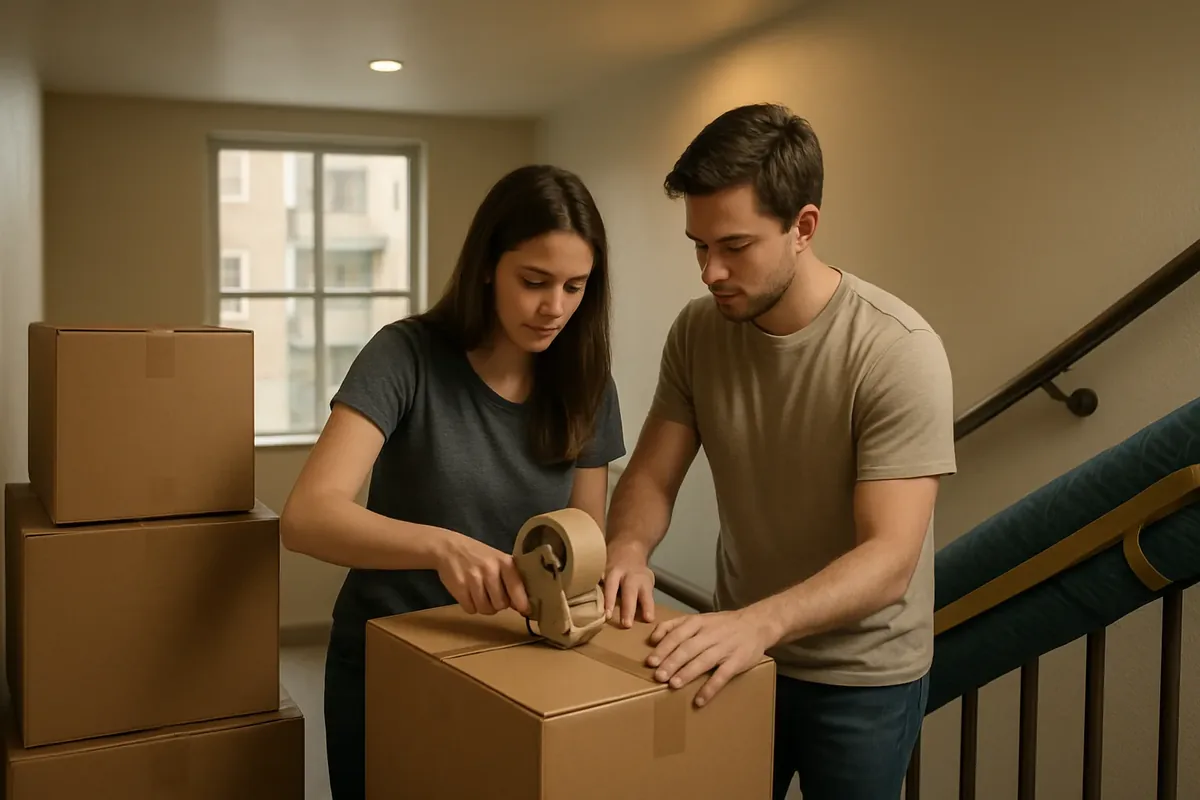
Before the crew arrives for a SIT pickup, seal every corrugated box seam with reliable 2.6-mil acrylic tape like Duck EZ Start Frustration-Free Quiet Packaging Tape (1.88 in x 55 yd, 2.6 Mil Quiet Release, 6 Rolls), which unrolls quietly during late-night apartment packing without waking neighbors through thin walls. For beds entering open warehouse racks or vaults, encase King memory-foam mattresses in a Nordrana Heavy-Duty Reusable Tarp Mattress Moving Bag (King 82x79x15 in, 180 GSM woven tarp with 8 reinforced handles and a full zippered enclosure) so movers can steer the bed cleanly around tight stair landings without tearing plastic. For Twin, Twin-XL, or Full studio mattresses, slide each bed into Uboxes 4-Mil Heavy-Duty Clear Twin & Full Mattress Moving & Storage Bags (4.0 Mil Clear Poly, 2-Pack) and tape the open cuff tight against warehouse dust and damp air.
Plug your apartment size, mileage, stair flights, and packing choices into our Apartment Moving Cost Calculator and Movers vs. DIY Rental Truck Comparator to see whether full-service SIT or a two-leg DIY rental truck plus self-storage saves you more.
Open Calculator →Frequently Asked Questions
Why am I charged both a warehouse handling fee and a delivery-out-of-SIT fee?+
Warehouse handling-in and handling-out pays strictly for dock and warehouse labor inside the facility—unloading the truck into numbered 5x7x7 wooden vaults, wrapping, stenciling, forklift racking, and later staging your vaults back at the loading bay. Delivery Out of SIT is a separate transportation charge covering the box truck, fuel, driver, local crew hours (plus the standard 1-hour travel fee), and unloading into your new apartment.
Does a binding interstate moving estimate lock in warehouse handling-in and out fees?+
Only if Storage-in-Transit was explicitly included on the written binding estimate before pickup. If you add SIT after signing because your new apartment lease start date slipped, federal FMCSA rules allow the carrier to bill SIT handling-in/out, daily storage, SIT valuation, and redelivery at its published tariff rates via a written addendum.
How does California Double Drive Time (DDT) affect local SIT redelivery bills?+
On intrastate local moves in California regulated under the BHGS MAX 4 tariff, movers must double the actual driving time between your origin apartment and the warehouse (and later between the warehouse and your destination apartment) instead of billing an arbitrary flat travel fee. If the carrier's warehouse sits 45 minutes from your new apartment, DDT adds 90 minutes of billed crew time to your delivery-out invoice.
Can I access my wooden storage vault to grab clothes or documents during SIT?+
Usually only by appointment and for a steep warehouse access fee—typically $50 to $125 per vault pull because a forklift operator must retrieve and unstack your crate from the rack. Pack a dedicated 30-day suitcase and keep leases, medications, and electronics out of any SIT shipment.
Should I use 32-ECT or 48-ECT boxes and 4-mil mattress bags for warehouse vault storage?+
Standard 32-ECT boxes handle books and linens well, but heavy kitchenware stacked 7 feet high inside a wooden vault should go into 48-ECT double-wall dish barrel boxes to prevent bottom-tier collapse. Pair them with 4-mil polyethylene or 180-GSM zippered tarp mattress bags so warehouse dust and rack contact never stain upholstery.
Interactive US Moving Tools
Compare Full-Service Movers vs. DIY Rental Truck in 30 seconds
Related Guides
moving quotes insurance and hidden fees
Moving Quotes, Building COI & Hidden Fees: Complete US Benchmarks & Guides
Lowball apartment moving quotes routinely balloon by 35% to 90% on moving day once walk-up stair charges, long-carry penalties, travel-time minimums, building Certificate of Insurance (COI) delays, and valuation upgrades hit the Bill of Lading. This pillar guide decodes binding vs. non-binding contracts, FMCSA $0.60/lb vs. Full Value coverage, landlord COI rules, and exact hidden fee benchmarks.
moving quotes insurance and hidden fees
Costly Mistakes Renters Make on Warehouse Handling-In and Out Vault Fees
Uncover the fine-print billing traps, vault-padding tactics, and double-handling loopholes that inflate storage-in-transit invoices by $250 to $950+. Learn how to audit carrier quotes and protect your boxes before your apartment goods enter a warehouse.

moving quotes insurance and hidden fees
Questions to Ask Your Mover Before Signing: Warehouse Handling-In & Out Vault Fee Checklist
Use this step-by-step pre-deposit audit checklist and contract clause guide to verify warehouse handling-in and handling-out vault fees before booking Storage-in-Transit. Lock in exact per-cwt or per-vault caps, COI deadlines, and redelivery rates in writing.

moving quotes insurance and hidden fees
What Counts as a 'Bulky Article' on Regulated Mover Rate Schedules?
Decode how interstate and state moving tariffs classify bulky articles and apply constructive weight additives of 700 to 2,000 lb to awkward apartment gear. Compare full-service specialty item fees against renting a DIY moving truck.