In this guide
- What the Unverified Internal Electronics Clause Actually Excludes
- Why External Damage Standards Hit Apartment Renters Hardest
- Cost Breakdown: Full-Service Valuation & Packing vs. DIY Transport
- How 'Packed By Owner' (PBO) Interacts With Internal Electronics Waivers
- Building COI Rules, Elevator Delays, and Protecting Bulky Goods Alongside Electronics
- 5 Ways to Neutralize the Unverified Internal Electronics Clause
What the Unverified Internal Electronics Clause Actually Excludes
Turn over almost any US residential Bill of Lading (BOL) or Order for Service and you will find a paragraph titled 'Mechanical and Electrical Derangement' or 'Unverified Internal Electronics.' The wording is blunt: unless the mover's crew witnesses external physical trauma—a punctured 32-ECT carton, a shattered glass bezel, or a crushed steel side panel—the carrier disclaims liability for internal circuit board failures, cracked OLED substrates beneath intact glass, uncalibrated turntable tonearms, or displaced washing-machine drum bearings.
From an underwriting standpoint, carriers rely on this clause because movers cannot visually verify whether a 5-year-old OLED panel, high-end espresso machine, or direct-drive compact washer functioned properly before loading. Even when a 3-person crew rides down a freight elevator or navigates two flights of 3rd-floor walk-up stairs, road vibration inside a 15-ft or 26-ft leaf-spring box truck can snap a brittle solder joint or misalign a smart-bike torque sensor without leaving a single scratch on the exterior plastic.
Why External Damage Standards Hit Apartment Renters Hardest
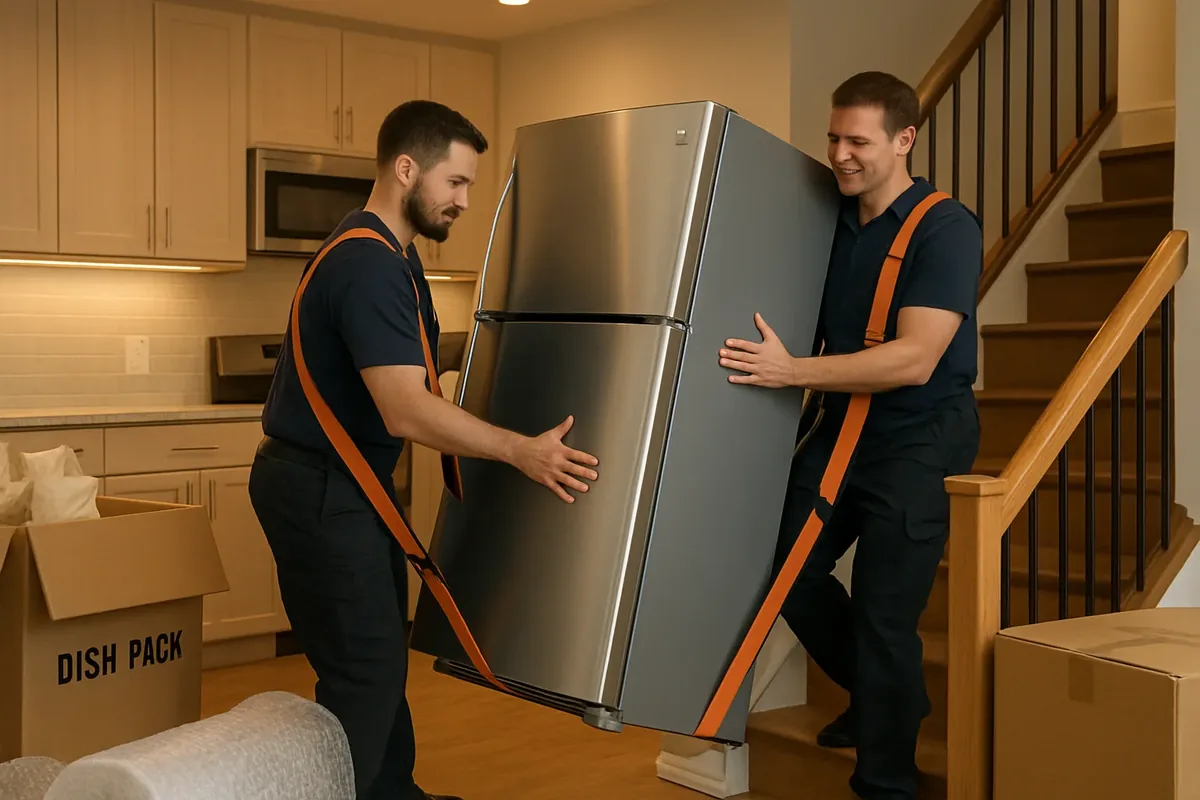
Apartment relocations multiply vibration and tilt hazards compared with single-story suburban homes. A 1-bedroom apartment move (roughly 420 cu ft and 3,200 lbs) frequently funnels high-value electronics through narrow 32-inch entry doors, shared passenger elevators, or multi-flight walk-up stairwells. When a crew tips a smart refrigerator or compact apartment washer beyond 45 degrees on a hand truck to clear a landing turn, compressor oil can migrate into cooling lines—producing a dead appliance at destination with a spotless outer shell.
Heavy specialty items trigger both surcharge fees and waiver forms. Under standard US apartment moving benchmarks, moving a compact washer/dryer pair or a Peloton bike adds $75–$160 in heavy-appliance handling fees on top of base hourly labor ($130–$175/hr for a 2-person crew on a 1-bedroom, or $175–$235/hr for a 3-person crew on a 2-bedroom). Many carriers require you to sign a separate Appliance & Calibration Waiver right at pickup, stating they neither disconnect water lines nor guarantee drum leveling, Wi-Fi module continuity, or power-supply function after transit.
Amazon US Apartment Moving Supplies
Recommended Moving Boxes, Blankets & Bags for This Move
Apartment moving supplies matched to this guide (Amazon.com affiliate ID: apartmentmovingcost-20).
Heavy-Duty Reusable Tarp Mattress Moving Bag with 8 Reinforced Handles & Zipper (Queen)
Waterproof 180-GSM woven polyethylene tarp mattress carrier with 3-sided heavy zipper and 8 stair-lifting handles
5-Mil Extra-Thick Clear Polyethylene King & Cal-King Mattress Moving Bags (2-Pack)
Oversized 104"x82"x16" 5-mil clear plastic bags with extra flap length for double-taping shut
6-Mil Ultra-Thick Mattress Vacuum Compression Bag with Straps for Memory Foam (Queen/King)
Air-tight vacuum roll-up compression bag + 4 cinch straps shrinking a thick foam mattress by 75% to fit an SUV
As an Amazon Associate I earn from qualifying purchases. Always verify live stock and pack sizing directly on Amazon.com.
Cost Breakdown: Full-Service Valuation & Packing vs. DIY Transport
Deciding whether to let movers pack your electronics—and pay for higher valuation—or transport fragile electronics yourself in a personal vehicle or DIY rental truck comes down to hard numbers. Below is a benchmark comparison for a local under-15-mile apartment move (12 miles average) across Studio, 1-Bedroom, and 2-Bedroom floor plans, showing labor, truck/transport, materials, and electronics protection adjustments.
| Apartment Size & Volume | Full-Service Base Labor + Travel | Local Transport & Heavy-Appliance Add-On | Materials (Mover-Packed vs. DIY Kit) | DIY Rental Truck + Fuel (1 Day, 12 mi) | Electronics Valuation / Protection Gap |
|---|---|---|---|---|---|
| Studio (250 cu ft / 2,000 lbs) | $500–$825 (2 movers, 3–4 hrs + 1 hr travel) | $75–$145 transport (+$75–$160 if washer/Peloton) | $180–$320 mover-packed / $65–$110 DIY | $36–$51 (10-ft truck + $4 fuel @ $3.55/gal) | FVP adds ~$95–$160; $0.60/lb pays just $24 for a 40-lb TV |
| 1-Bedroom (420 cu ft / 3,200 lbs) | $650–$1,225 (2 movers, 4–6 hrs + 1 hr travel) | $75–$145 transport (+$75–$160 heavy appliance) | $290–$520 mover-packed / $95–$160 DIY | $47–$62 (12–15 ft truck + $4 fuel) | FVP adds ~$140–$240; PBO cartons void most internal claims |
| 2-Bedroom (680 cu ft / 5,400 lbs) | $1,050–$1,998 (3 movers, 5–7.5 hrs + 1 hr travel) | $75–$145 transport (+$75–$160 heavy appliance) | $460–$820 mover-packed / $145–$235 DIY | $59–$78 (15–20 ft truck + $4 fuel) | FVP adds ~$210–$360; third-party rider ~$75–$150 extra |
| 3-Bedroom (980 cu ft / 7,800 lbs) | $1,650–$3,098 (4 movers, 6.5–9.5 hrs + 1 hr travel) | $75–$145 transport (+$75–$160 heavy appliance) | $680–$1,180 mover-packed / $205–$330 DIY | $70–$95 (20–26 ft truck + $4 fuel) | FVP adds ~$310–$520; custom TV crating $85–$175 per unit |
Notice the liability cliff under default Released Value Protection: a 40-lb, 65-inch OLED television worth $1,800 yields a maximum payout of exactly $24 at $0.60 per pound, and only if the screen glass visibly shatters. If the power board fractures internally while the double-wall TV box remains uncreased, the carrier pays $0 under both Released Value and standard FVP unless you hold a mechanical-derangement endorsement or proved carrier mishandling.
How 'Packed By Owner' (PBO) Interacts With Internal Electronics Waivers
Even when you upgrade to Full Value Protection, self-packing your TV, desktop PC, or turntable triggers the dreaded 'PBO' (Packed By Owner) code on the household goods inventory sheet. Carriers legally argue that if you packed the device yourself, internal shock damage stems from insufficient interior suspension—such as missing corner foam blocks or weak 32-ECT single-wall cardboard instead of 48-ECT double-wall cartons—rather than rough handling.
That creates an important strategic split for budget-conscious apartment renters. Rather than paying $290–$520 for full mover-packing across a 1-bedroom apartment, you can pack books, linens, and dishware yourself while paying the mover selectively—typically $65–$120 in labor and carton fees—to pack and mirror-box only your primary TV and high-value electronics. Alternatively, hauling sensitive electronics in your own car eliminates the BOL waiver debate altogether while leaving bulky furniture and mattresses to the moving crew.
Building COI Rules, Elevator Delays, and Protecting Bulky Goods Alongside Electronics
While you focus on electronics waivers, do not overlook how building Certificate of Insurance (COI) rules and elevator access fees inflate the same invoice. Reserving a freight elevator in an urban high-rise adds 0.5–1.0 hours and $45–$95 in staging and COI check-in surcharges, while a shared passenger elevator without reservation adds 1.0–1.75 hours and $85–$175. When a building superintendent pauses loading because a COI is missing, crews rush to finish within a 4-hour freight window—and rushed crews are far more likely to drop a stacked washer or bump an unpadded TV carton against a doorframe.
Protecting non-electronic anchor items properly also saves crew minutes so movers can take their time on delicate gear. Encasing a queen bed in a Heavy-Duty Reusable Tarp Mattress Moving Bag with 8 Reinforced Handles (180-GSM woven polyethylene tarp with a 3-sided heavy zipper) lets two carriers clear narrow walk-up landings without dragging fabric across greasy elevator tracks. For king beds and foundations, 5-Mil Extra-Thick Clear Polyethylene King & Cal-King Mattress Moving Bags provide tear-resistant moisture sealing with oversized flaps for double-taping. If you are opting for a hybrid DIY approach to move a memory foam mattress in an SUV alongside your boxed PC monitor and audio receiver, a 6-Mil Ultra-Thick Mattress Vacuum Compression Bag (PA+PE valve construction with 4 cinch straps) reduces foam bulk by up to 75%.
5 Ways to Neutralize the Unverified Internal Electronics Clause
- Record a Timestamped Power-On Video Before Pickup. Film every TV, monitor, espresso machine, and smart appliance running a diagnostic screen or cycle with your phone showing the current date and the device's rear serial-number plate. While video does not force a carrier to waive a tariff exclusion automatically, it eliminates the claim that an item was 'already dead before loading' during arbitration or third-party transit claims.
- Install Factory Shipping Bolts on Front-Load Washers. Before movers touch an in-unit front-load washing machine, re-insert all four manufacturer transit bolts into the rear drum housing. Moving a front-load washer without shipping bolts allows the concrete counterweight drum to slam against internal sensors and plastic tubs—damage carriers universally deny under both improper preparation and internal mechanical clauses.
- Request a Written Valuation Schedule for Items Over $100/lb. Under FMCSA interstate rules, items exceeding $100 per pound (such as MacBook Pros, OLED panels, mirrorless cameras, or audiophile DACs) are 'Items of Extraordinary Value.' Declare them on the High-Value Inventory Form before loading; otherwise, the mover's liability caps at $100 per pound even under Full Value Protection.
- Buy Third-Party Mechanical & Electrical Derangement Coverage. Specialty moving insurers such as Relocation Insurance Group or Baker International sell trip-transit riders that explicitly cover internal electronic failure when professionally packed, typically costing 1.5%–2.5% of declared value ($75–$150 on $5,000 of electronics) with a $250–$500 deductible.
- Keep Zero-Tolerance Calibration Gear in Your Personal Vehicle. If you are moving locally (<15 miles) or extended metro (15–50 miles), transport desktop PCs with heavy GPUs, calibrated studio monitors, vinyl turntables, and OLED TVs under 55 inches in your own car or a dedicated 10-ft rental cargo van ($20–$30 daily base plus $0.99–$1.39/mi local) where you control every speed bump.
Ready to see how carrier packing, heavy-appliance handling fees, and Full Value Protection change your bottom line? Run your exact apartment size, flight count, and distance in our Apartment Moving Cost Calculator or compare total costs in the Movers vs. DIY Rental Truck Comparator.
Open Calculator →Frequently Asked Questions
Can a mover legally deny my broken TV claim if the cardboard TV box has no dents?+
Yes, in most cases. Both interstate FMCSA-filed tariffs and state intrastate tariffs allow carriers to exclude 'mechanical or electrical derangement' when there is no external evidence of rough handling or carton impact. Unless you prove visible mishandling—such as a crushed corner, dropped carton noted on the delivery receipt, or carrier-witnessed impact—standard Released Value ($0.60/lb) and even Full Value Protection claims for internal screen failure are routinely denied.
Does California Double Drive Time (DDT) or a 1-hour travel fee apply when movers wait for appliance disconnection?+
Yes. On local hourly apartment moves outside California, movers typically charge a flat 1.0-hour travel fee ($125–$295 depending on crew size), and any wait time while you shut off water valves or hunt for washer shipping bolts runs straight on the hourly clock. In California, BHGS rules enforce Double Drive Time (DDT) for driving between origin and destination, while on-site delays waiting for appliance prep still accrue at the standard hourly crew rate.
Will my renter's insurance cover internal electronics damage during an apartment move?+
Usually not. Standard HO-4 renter's insurance policies cover 'named perils' such as fire, theft, or vehicle collision during transit, but almost universally exclude breakage, rough handling, and unexplained mechanical or electrical failure while moving. Even if a covered peril occurs, a $500–$1,000 deductible often wipes out the payout on a mid-range TV or appliance.
How do walk-up stair fees and elevator access affect fragile appliance handling?+
Walk-up stairs significantly increase both labor cost and tilt risk. A 3rd-floor walk-up (2 flights) adds 1.0–1.75 hours and $110–$190 in surcharges, while a 4th- or 5th-floor walk-up adds 1.75–3.0 hours and $185–$340. Carrying a 180-lb compact washer or 65-inch TV carton down multiple tight landings multiplies shock vibration, making carrier-performed packing or a specialty third-party transit rider much more valuable than on a ground-floor dock move.
What is the difference between a binding estimate and a non-binding estimate when adding TV crating or appliance fees?+
Under FMCSA interstate regulations, a binding estimate locks your total price based on the itemized inventory and services listed—so if you add custom TV crating ($85–$175) or a Peloton move ($75–$160) on moving day, the carrier must issue a revised written order before loading. Under a non-binding estimate, movers can bill actual weight and added packing services up to 110% of the estimate at delivery and invoice the remaining balance 30 days later.
Interactive US Moving Tools
Compare Full-Service Movers vs. DIY Rental Truck in 30 seconds
Related Guides
moving quotes insurance and hidden fees
Moving Quotes, Building COI & Hidden Fees: Complete US Benchmarks & Guides
Lowball apartment moving quotes routinely balloon by 35% to 90% on moving day once walk-up stair charges, long-carry penalties, travel-time minimums, building Certificate of Insurance (COI) delays, and valuation upgrades hit the Bill of Lading. This pillar guide decodes binding vs. non-binding contracts, FMCSA $0.60/lb vs. Full Value coverage, landlord COI rules, and exact hidden fee benchmarks.
moving quotes insurance and hidden fees
Loopholes & Surprise Fees to Watch: Unverified Internal Electronics Clause Contract Traps
Uncover the seven fine-print loopholes movers use to dodge TV, gaming PC, and smart appliance claims—and the padded packing fees tucked into move-day waivers. Learn how to spot predatory language before your moving truck pulls up.

moving quotes insurance and hidden fees
Pre-Move Audit Scorecard for the Unverified Internal Electronics Clause
Use this step-by-step pre-deposit scorecard to grill moving estimators on internal electronics exclusions, PBO carton rules, and calibration waivers before you sign. Includes exact written contract clauses to request and packing specs that hold up under claims review.

moving quotes insurance and hidden fees
Getting Exact Landlord Additional-Insured Wording & Waiver of Subrogation onto Your Mover COI
Decode the exact ACORD 25 Certificate of Insurance language high-rise landlords demand—including Additional Insured entities, Primary & Non-Contributory status, and Waiver of Subrogation riders. Learn how COI fees and freight elevator windows impact your moving budget.