In this guide
- Complete 1-Bedroom Apartment Box Count & Material Kit Spec
- Exact Tape Roll Quantity Math for a 1-Bedroom Apartment
- Room-by-Room Carton, Wrap & Blanket Allocation
- 32-ECT vs. 48-ECT Corrugated Boxes, Blankets & Space-Saving Totes
- DIY Supply Budget ($95–$160) vs. Full-Service Packing ($290–$520)
- 7-Day Packing Sequence to Finish Before Moving Morning
Complete 1-Bedroom Apartment Box Count & Material Kit Spec
Underestimating box and tape quantities on moving week forces expensive last-minute hardware-store runs or forces a two-person moving crew ($130–$175/hr) to wait while you scramble for extra cartons. Under US residential moving benchmarks, a standard 600–850 sq ft 1-bedroom apartment averages 420 cu ft and 3,200 lbs, translating directly to 37 cartons, 5 rolls of 2-inch packing tape, 12 quilted furniture blankets, and 1 mattress bag.
Your actual household density shifts these baseline counts cleanly using standard load multipliers: minimalist apartments (0.85x, ~357 cu ft / 2,720 lbs) trim roughly 15% of cartons and wrap, whereas heavily furnished units with full bookcases, home-gym gear, or extensive cookware (1.22x, ~512 cu ft / 3,904 lbs) require 22% more cartons and an extra roll or two of tape.
| Supply Item & Standard Spec | Minimalist Load (0.85x) | Standard 1-Bedroom (1.00x) | Heavy Furnished (1.22x) | Primary Room / Use Case |
|---|---|---|---|---|
| Small Boxes (16"×12"×12", 1.5 cu ft, 32-ECT) | 10 boxes | 12 boxes | 15 boxes | Books, vinyl, canned pantry food, tools, toiletries |
| Medium Boxes (18"×18"×16", 3.0 cu ft, 32-ECT) | 13 boxes | 15 boxes | 18 boxes | Dishware, pots, folded sweaters, desk electronics |
| Large Boxes (24"×18"×18", 4.5 cu ft, 32-ECT) | 7 boxes | 8 boxes | 10 boxes | Bedding, pillows, lampshades, winter coats, towels |
| Wardrobe Boxes (20"–24" bar, 32-ECT) | 1–2 boxes | 2 boxes | 2–3 boxes | Suits, dresses, collared shirts on hangers |
| Total Carton Count | 31–32 boxes | 37 boxes | 45–46 boxes | Full 600–850 sq ft apartment enclosure |
| Packing Tape Rolls (2" × 55–110 yd acrylic) | 4 rolls | 5 rolls | 6–7 rolls | H-taping bottoms/tops, reinforcing dish packs, pad wrap |
| Quilted Moving Blankets (85-lb/dozen, 72"×80") | 10 blankets | 12 blankets | 15 blankets | Sofa, dresser, dining table, headboard, TV stand |
| Mattress Bags (5-mil polyethylene, Queen/King) | 1 bag | 1 bag | 1–2 bags | Primary mattress protection (+box spring if applicable) |
| DIY Supply Cost vs. Mover-Packed Invoice | $81–$136 DIY / $247–$442 Mover | $95–$160 DIY / $290–$520 Mover | $116–$195 DIY / $354–$634 Mover | 65%–70% savings buying your own supply kit |
Exact Tape Roll Quantity Math for a 1-Bedroom Apartment
Renters frequently buy two or three 55-yard rolls of tape and run out mid-evening before moving morning. Calculating tape roll quantity for a 1-bedroom apartment requires measuring linear feet per carton rather than guessing. Using the industry-standard H-taping technique—one center seam strip plus two edge-seal strips across both bottom and top flaps—every box consumes roughly 5.5 to 6.5 linear feet of 2-inch tape.
Across 37 standard cartons, basic sealing already consumes 215 to 240 linear feet (roughly 1.5 standard 55-yard / 165-foot rolls). Adding double-pass reinforcement on the bottom of 12 heavy book boxes and 15 medium kitchen boxes, taping seams on 2 wardrobe cartons and 3–4 mirror/art frames, securing 5-mil mattress bag flaps, and anchoring stretch-wrap ends brings real-world consumption to 580–720 linear feet. Four 55-yard rolls cover active sealing (~660 ft), and the 5th roll serves as a mandatory buffer for dispenser waste and last-minute open-top essentials—or step up to 110-yard commercial rolls if you plan to pre-seal 1.22x heavy loads.
Amazon US Apartment Moving Supplies
Recommended Moving Boxes, Blankets & Bags for This Move
Apartment moving supplies matched to this guide (Amazon.com affiliate ID: apartmentmovingcost-20).
VENO Heavy-Duty Zippered Moving Bags with Backpack Straps (10-Pack Blue)
Water-resistant woven polypropylene oversized moving totes replacing cardboard for clothes and bedding
Shorty Compact Wardrobe Moving Boxes with 20" Hanging Bars (4-Pack)
Low-clearance 20"x20"x34" wardrobe boxes that fit easily through narrow walk-up stair turns and SUVs
4-Piece Telescoping Mirror & Framed Art Corrugated Picture Boxes (3-Sets)
Adjustable four-panel corner-interlocking corrugated frame boxes fitting wall mirrors up to 40"x60"
As an Amazon Associate I earn from qualifying purchases. Always verify live stock and pack sizing directly on Amazon.com.
Room-by-Room Carton, Wrap & Blanket Allocation
Splitting the 37-box master count by room prevents overfilling large 4.5 cu ft boxes with dense dishware or books—the #1 cause of bottom blowouts on apartment stairs. Keep small 1.5 cu ft cartons under 40 lbs, medium 3.0 cu ft boxes under 45 lbs, and large 4.5 cu ft boxes strictly for lightweight, high-volume textiles.
| Apartment Zone | Carton Mix (37 Total) | Tape, Blankets & Protective Wrap | Weight Cap & Packing Rule |
|---|---|---|---|
| Kitchen & Pantry | 4 Small + 6 Medium | 1.5 tape rolls, 25 lb packing paper, 50 ft bubble wrap | Pack plates vertically on edge; keep medium boxes <= 40 lbs |
| Living Room & Dining | 5 Small + 4 Medium + 2 Large | 1.5 tape rolls, 6 quilted blankets, 1–2 telescoping art boxes | Use small boxes for books/records; blankets on sofa & coffee table |
| Primary Bedroom & Closet | 1 Small + 3 Medium + 5 Large + 2 Wardrobes | 1.25 tape rolls, 6 quilted blankets, 1 × 5-mil mattress bag | Hang coats/suits in wardrobes; seal mattress before hallway transit |
| Bathroom, Hall Closet & Entry | 2 Small + 2 Medium + 1 Large | 0.75 tape roll, 1 roll stretch wrap, 1–2 gallon zip pouches | Bag liquids upright in sealed liners; wrap broom/vacuum bundle |
32-ECT vs. 48-ECT Corrugated Boxes, Blankets & Space-Saving Totes
Standard 32-ECT (Edge Crush Test) single-wall kraft boxes carry up to 65 lbs when weight is evenly distributed and work cleanly for 90% of a 1-bedroom apartment. However, fragile stemware, cast-iron skillets, and glass coffee-table inserts benefit from upgrading specific cartons to 44-ECT or 48-ECT double-wall dish packs (which resist vertical crushing when stacked four-high inside a 15-ft truck) alongside woven polypropylene totes for walk-up clothing loads:
- VENO Heavy-Duty Zippered Moving Bags with Backpack Straps (10-Pack Blue): Engineered from water-resistant woven polypropylene rated at 50 lbs per 24-gallon tote, these backpack-strap bags replace 5–6 bulky large cardboard boxes for folded clothes, bedding, and winter coats—saving hallway width and eliminating tape assembly on 2nd- to 4th-floor walk-ups.
- Shorty Compact Wardrobe Moving Boxes with 20" Hanging Bars (4-Pack): Measuring 20"×20"×34" in 32-ECT corrugated board with steel hanging bars, compact shorty wardrobes pivot cleanly around tight 90-degree apartment staircase turns and fit upright in small SUVs or 12-ft trucks without snagging low lobby soffits.
- 4-Piece Telescoping Mirror & Framed Art Corrugated Picture Boxes (3-Sets): Built from four interlocking 32-ECT corner panels adjustable up to 40"×60"×4", these telescoping sleeves shield dresser mirrors, framed prints, and flat-screen wall art against corner impacts during dolly runs.
DIY Supply Budget ($95–$160) vs. Full-Service Packing ($290–$520)
When you self-pack a 1-bedroom apartment using the 37-box specification ($95–$160 total materials), a 2-mover local crew ($130–$175/hr) completes loading and unloading in 4.0 to 6.0 base hours plus the standard 1.0-hour travel fee—bringing total self-packed full-service move spend to $820–$1,530. Asking movers to pack those same 37 boxes adds $290–$520 in carrier-supplied cartons and packing labor, lifting your move bill to $1,015–$1,890.
Be aware that unsealed or half-packed boxes trigger costly delays: if a 2-person crew arrives to open-top bins and loose closet hangers, they must either supply and tape carrier cartons at retail per-box tariffs ($6–$18 per box plus labor) or refuse liability for loose items under standard FMCSA released-value rules.
7-Day Packing Sequence to Finish Before Moving Morning
- Day 7: Assemble 12 Small Boxes & Pack Books/Off-Season Gear. H-tape all 12 small 1.5 cu ft boxes, fill books flat (spine down), pack seasonal decor and tools, and stage neatly along one living-room wall.
- Day 5: Pack Non-Essential Kitchen Cabinets & Wall Art. Wrap baking sheets, glasses, and small appliances individually in packing paper inside 6 medium 32-ECT cartons; slide framed mirrors into 4-piece telescoping sleeves.
- Day 3: Transfer Closets Into Shorty Wardrobes & Zippered Totes. Load hanging jackets and shirts directly onto 20-inch metal wardrobe bars and pack folded linens and blankets inside backpack-strapped polypropylene totes.
- Day 1: Seal Daily Kitchenware, Electronics & Mattress Bag. Leave only one open-top essentials box for coffee gear and toiletries, slip the primary queen mattress into a 5-mil polyethylene bag sealed with tape, and stack sealed cartons 3-to-4 high near the entry.
Want to price your exact box kit against 2-mover hourly labor or a 12–15 ft DIY rental truck? Plug your 1-bedroom square footage, furniture load density, and stair flights into our Apartment Moving Cost Calculator or Movers vs. DIY Rental Truck Comparator.
Open Calculator →Frequently Asked Questions
Are 5 rolls of packing tape really enough for 37 boxes in a 1-bedroom apartment?+
Yes—if you purchase 2-inch-wide, 2.0-to-2.6-mil acrylic rolls measuring at least 55 yards (165 feet) per roll. Thirty-seven boxes H-taped top and bottom use about 220–240 linear feet, and double-taping heavy book bottoms, reinforcing dish packs, and sealing a 5-mil mattress bag brings total demand to 580–720 linear feet—leaving roughly one spare roll from a 5-roll pack (825 total feet). Avoid thin 1.6-mil dollar-store rolls that snap mid-pull and run only 30–40 yards.
When should I upgrade from 32-ECT boxes to 44-ECT or 48-ECT double-wall cartons?+
Standard 32-ECT single-wall boxes safely handle up to 65 lbs and cover clothing, bedding, pantry staples, and normal household items. Upgrade specifically to 44-ECT or 48-ECT double-wall dish-pack cartons for fine china, wine glasses, heavy ceramic dinnerware, or cast-iron cookware—especially if your move involves 2nd-to-5th-floor walk-up stairs or interstate transit where boxes sit stacked five tiers high inside a freight trailer.
Why does the 1-bedroom kit specify 12 quilted 85-lb moving blankets instead of thin felt pads?+
Light 35-lb-per-dozen woven textile skins tear easily on doorframes and offer minimal dent cushioning. Heavy 85-lb-per-dozen quilted polyester/cotton blankets (~7 lbs per 72"×80" blanket) absorb dolly vibration and guard sofa corners, dresser tops, dining tabletops, and TV stands against metal truck E-track scuffs. Twelve blankets cover every major furniture piece in a 600–850 sq ft apartment without leaving raw wood exposed.
What happens if my 1-bedroom apartment is a 3rd-floor walk-up—do my box rules change?+
Your total carton count stays near 37 boxes, but box weight discipline becomes critical. A 3rd-floor walk-up adds 1.0–1.75 extra crew hours and $110–$190 in stair surcharges; keeping small boxes under 35 lbs and replacing oversized 4.5 cu ft cardboard cartons with 50-lb-rated backpack-strap polypropylene totes lets carriers haul clothes safely up two flights without torn handles.
Do full-service movers require a building COI or taped boxes before move day?+
Most managed US apartment buildings require a Certificate of Insurance (COI) naming the property owner as additional insured at least 48–72 hours prior to move day, regardless of how neatly you packed. Additionally, under standard FMCSA carrier tariffs and non-binding/binding estimates, movers cannot stack unsealed open boxes onto hand trucks and will either charge extra hourly packing time to tape them or note them as PBO (Packed by Owner) with limited liability.
Interactive US Moving Tools
Compare Full-Service Movers vs. DIY Rental Truck in 30 seconds
Related Guides
moving cost by apartment size
Moving Cost by Apartment Size & Bedrooms: Cubic Feet, Truck Sizes & Crew Benchmarks
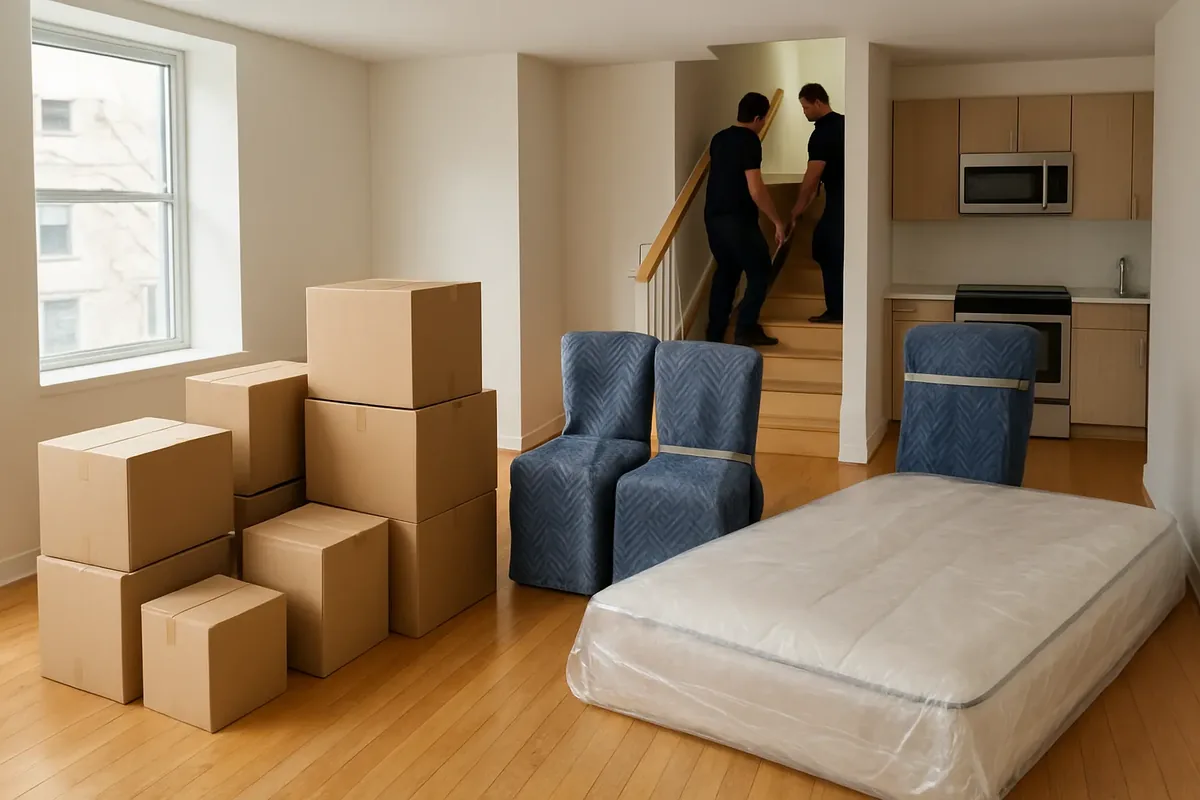
Moving an apartment scales sharply across cubic footage, shipment weight, crew headcount, and truck length—from 250 cu ft in a 350–550 sq ft studio to 1,280 cu ft in a 4-bedroom loft. This guide maps exact US labor hours, DIY truck dimensions, minimalist-to-heavy density multipliers, and box kit counts for every apartment floor plan.
moving cost by apartment size
1-Bedroom + Den Office Apartment Moving Cost: Crew Size, Hours & Budget Breakdown
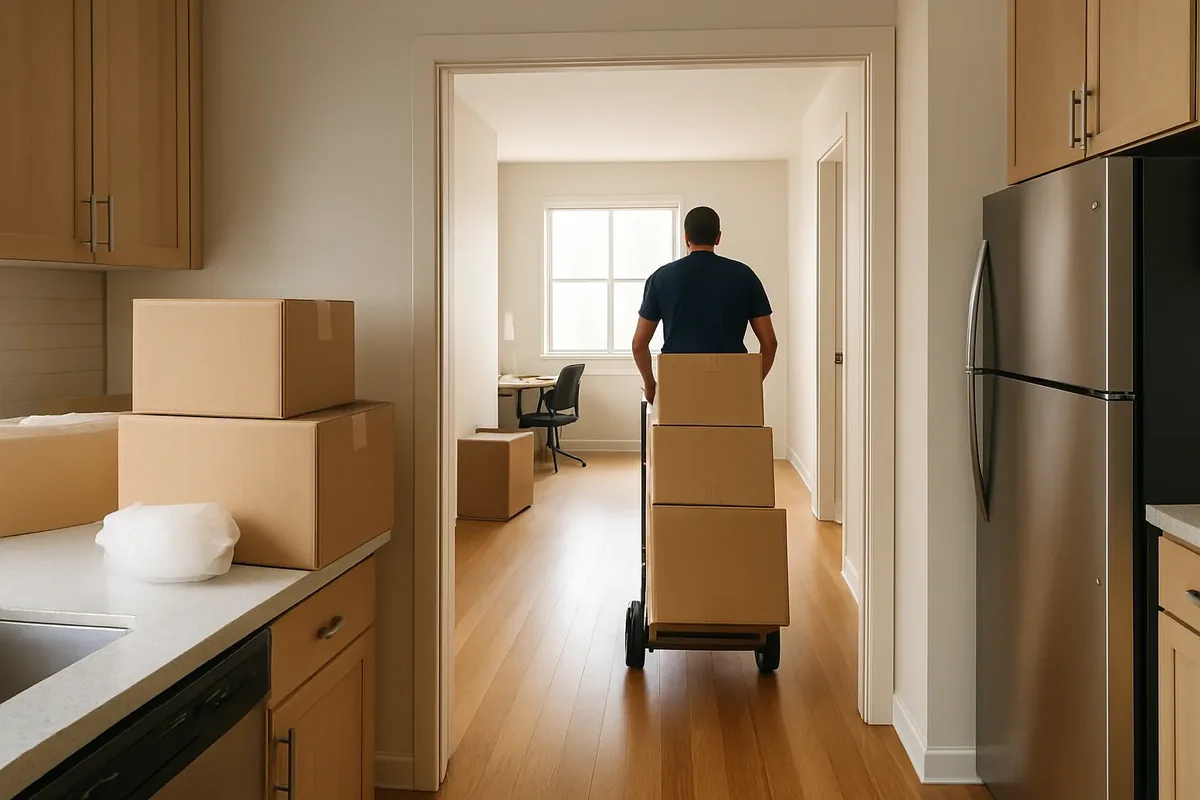
Moving a 1-bedroom + den home-office apartment (750–1,000 sq ft, 540 cu ft, 4,200 lbs) costs significantly more than a standard 1-bedroom due to heavy desks, monitors, shelving, and 44+ cartons. Compare 2-mover vs. 3-mover crew hourly benchmarks, walk-up stair fees, and long-distance truck rates.
moving cost by apartment size
1-Bedroom + Den Apartment Truck Size, Cubic Feet & Crew Headcount Math
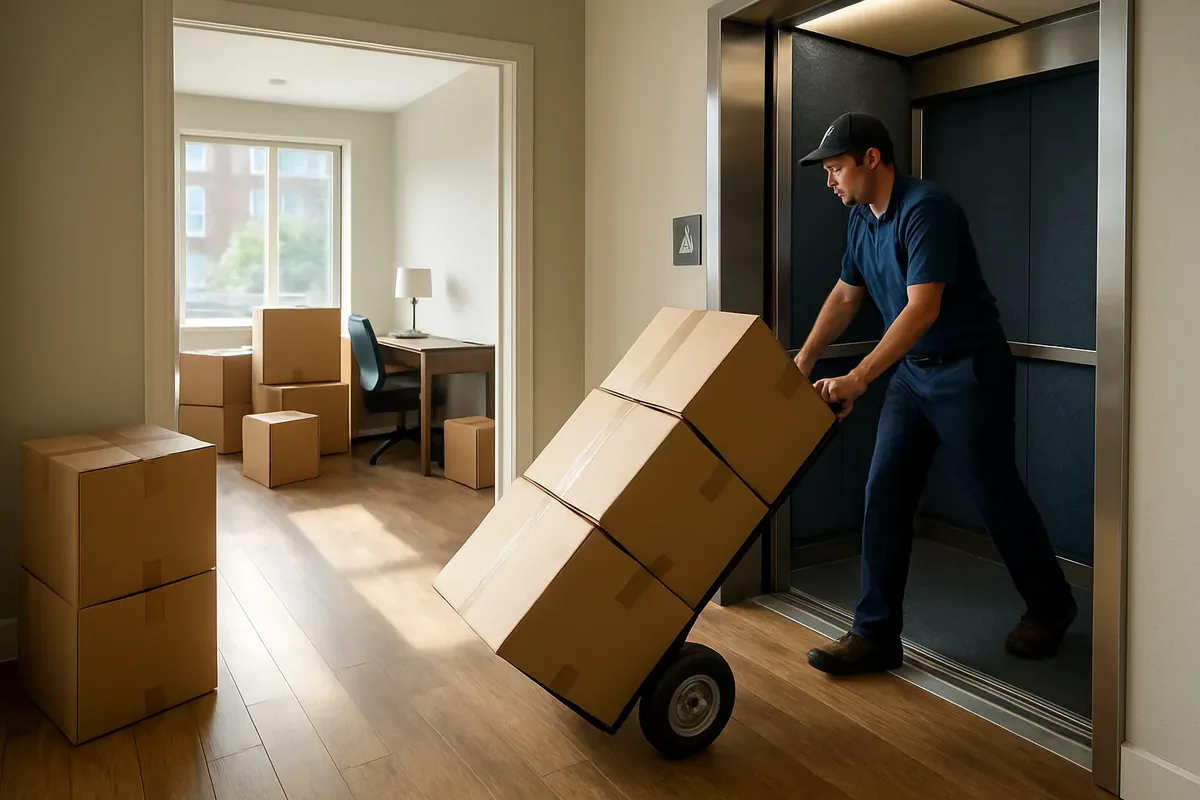
A 1-bedroom + den home-office apartment averages 540 cubic feet and 4,200 pounds—exceeding a 10-ft or 12-ft cargo van once you account for 15%–20% dead-space loss around desks and futons. Learn exact truck dimensions, payload limits, and when to step up from 2 to 3 movers.
moving cost by apartment size
1-Bedroom + Den Office Box Count, Cushioning Wrap & Packing List
Packing a 1-bedroom + den home-office apartment requires 44 corrugated cartons, 6 tape rolls, 15 quilted blankets, 1–2 mattress bags, and dedicated cushioning wrap for monitors, printers, and floor lamps. Compare DIY supply totals ($118–$195) against mover-packed tariffs ($365–$650).