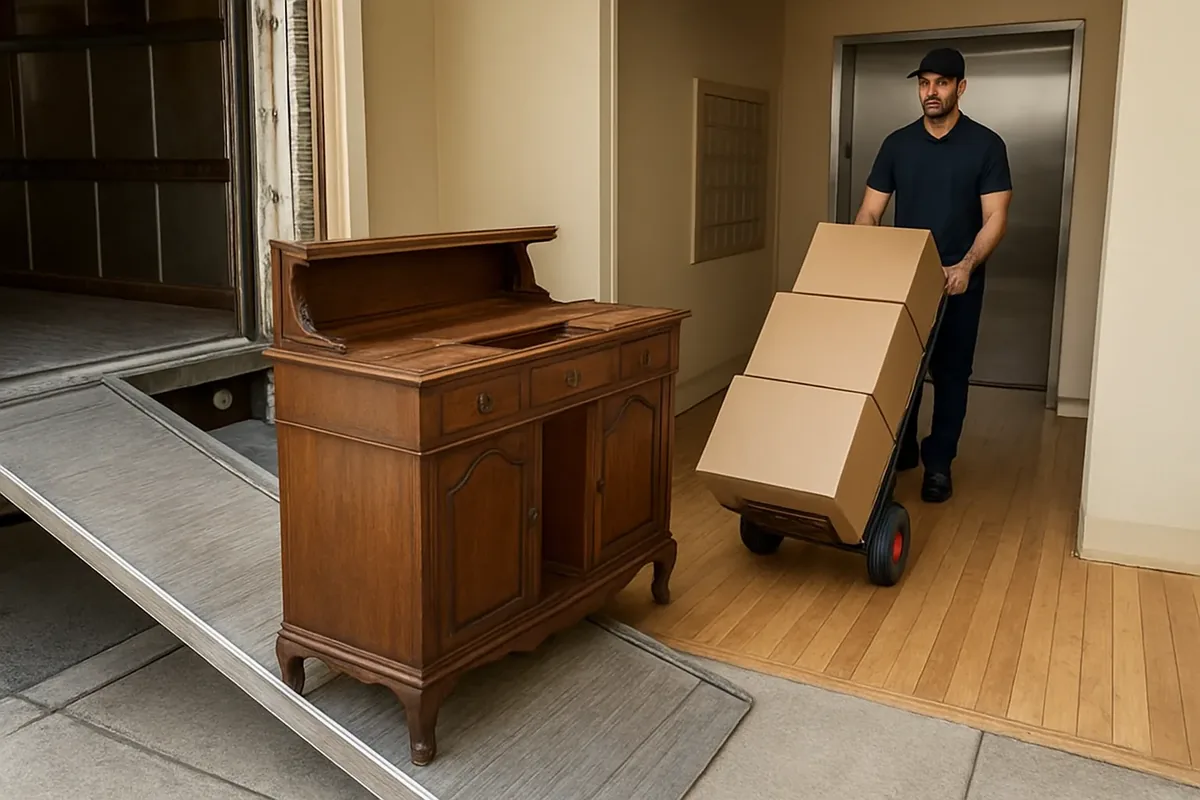
In this guide
- What Can (and Should Never) Be Unbolted on an Antique Sideboard
- Diagonal Doorway, Hallway Turn, and Elevator Cab Clearance Math
- How Pre-Disassembly Cuts Your Hourly Apartment Moving Quote
- Step-by-Step Hardware Bagging and Drawer Indexing Protocol
- Recommended Disassembly and Labeling Tools for Antique Buffets
- Destination Fit Check: What to Do If the Sideboard Fails Doorway Math
What Can (and Should Never) Be Unbolted on an Antique Sideboard
Modern flat-pack credenzas rely on cam locks and knock-down bolts; antique heirloom wood buffets and sideboards do not. Attempting to pry apart glued mortise-and-tenon joinery or antique dowels will snap century-old hide glue joints and split irreplaceable veneer. Before touching a screwdriver, inspect the underside and rear backboard of your sideboard to separate true bolted assemblies from permanently glued frames.
- Always separate two-piece china hutch tops: Most antique dining hutches sit on the sideboard deck using gravity, wooden alignment dowels, and two or three brass or steel mending plates screwed across the rear seam. Unscrew the rear plates and lift the hutch straight up—never drag it forward across a waxed veneer deck.
- Unbolt gallery mirrors and splashbacks: Victorian, Edwardian, and 1920s buffets frequently feature beveled back mirrors held by twin vertical wood support standards bolted into the rear apron. Removing the standards lowers overall piece height by 14 to 28 inches and eliminates the top-heavy glass snap hazard.
- Pull out all drawers, silverware trays, and adjustable shelves: Removing six solid-wood dovetail drawers cuts 45 to 85 pounds from the carcass and eliminates torque across corner glue blocks. Pull out wooden or brass shelf support pegs so they cannot rattle loose and scratch the interior.
- Remove or invert protruding brass hardware: Delicate drop-bail handles, lion-head rings, and carved wood knobs snag on doorway trim and tear through moving blankets. Unscrew the rear nut, place the pull inside the drawer (or screw it backwards facing into the interior), and re-tighten lightly so every knob stays married to its original drawer.
- Leave glued legs intact, unbolt corner-block legs only: Early Hepplewhite tapered legs and Queen Anne cabriole legs are usually mortised directly into the apron and must stay attached. Only unbolt legs if you clearly see threaded hanger bolts or corner-block lag screws—common on 1930s–1960s Duncan Phyfe and mid-century sideboards.
Diagonal Doorway, Hallway Turn, and Elevator Cab Clearance Math
Do not measure the nominal width of an apartment door slab—measure the actual clear opening between the inner doorstop molding and the open door face (or remove the hinge pins to gain an extra 1.5 to 2 inches). A nominal 32-inch US apartment entry door often yields only 29.5 to 30 inches of true clear width, and narrow interior dining or hallway doors frequently drop to 26–28 inches.
When turning a 66-to-74-inch sideboard through a 90-degree apartment hallway turn into a doorway, length alone rarely stops the move—depth and vertical diagonal height do. If a buffet is 22 inches deep, it clears a 29.5-inch doorway straight through with 7.5 inches to spare for quilted blankets (which add 1.5 to 2 inches of total thickness). However, if the hallway outside the door is only 38 inches wide, a 72-inch sideboard cannot swing flat around the corner; movers must tip it vertically on end. To verify vertical tip clearance, calculate the diagonal sweep: square root of (Length squared + Depth squared). A 68-inch long by 22-inch deep buffet has a 71.5-inch diagonal sweep—easily clearing an 80-inch doorway header and 96-inch ceiling—whereas a 78-inch by 24-inch buffet sweeps 81.6 inches and will bind under a standard 80-inch door frame unless tilted obliquely through the opening first.
| Apartment Chokepoint | Typical US Clear Dimension | Max Blanket-Wrapped Buffet Fit (Flat) | Vertical End-Up Fit Rule | Cost Risk If Misjudged |
|---|---|---|---|---|
| Unit Entry Door (Nominal 32"–36") | 29.5"–33.5" W x 79"–80" H | Up to 27"–31" deep (after 2" pad allowance) | Diagonal sweep must be <= 78" to stand upright under header | Door removal +15 min ($35–$55) or hallway scratch |
| Interior Hallway 90-Degree Turn | 36"–42" corridor width | Buffets <= 60" L x 20" D swing flat cleanly | Buffets > 62" L require standing vertically; check 96" ceiling clearance | Stuck piece adds 30–60 min crew maneuvering ($65–$175) |
| Shared Passenger Elevator Cab | 32"–36" door; 54"–68" cab depth; 88"–96" ceiling | Buffets <= 64" L fit flat only in 68"-deep cabs | 66"–82" buffets must stand vertically; verify door header >= 84" or diagonal entry | Shared elevator bottleneck ($85–$175) or stair carry pivot |
| Reserved Freight / Service Elevator | 42"–48" door; 72"–96" cab depth; 96"–108" ceiling | Up to 84"–92" L rolls in flat on 4-wheel dolly | Rarely needed unless moving a 9-foot European refectory sideboard | Freight elevator staging ($45–$95) — fastest & safest path |
| Pre-War Walk-Up Stairwell Landing | 34"–38" stair width; 38"x76" half-landing | Buffets <= 54" L navigate switchback landings | 60"–74" buffets require tilting over banister rail; verify overhead soffit height | 2nd–5th floor walk-up surcharge ($55–$340) + 3rd carrier |
Amazon US Apartment Moving Supplies
Recommended Moving Boxes, Blankets & Bags for This Move
Apartment moving supplies matched to this guide (Amazon.com affiliate ID: apartmentmovingcost-20).
DEWALT 8V MAX Gyroscopic Cordless Screwdriver & Hex Bit Set for Bed Disassembly
Motion-activated variable-speed cordless screwdriver + Allen/Hex bits speeding up IKEA and platform bed breakdown
Scotch H180 Heavy-Duty Pistol-Grip 2-Inch Packing Tape Gun Dispenser
Steel-and-high-impact plastic side-loading tape gun with adjustable hub brake for 2-inch moving rolls
Color-Coded Apartment Moving Box Labels for 4 Bedrooms & Fragile (600 Stickers)
High-contrast color-coded adhesive labels for Master Bedroom, Bedroom 2, Kitchen, Living Room, Bath, and Fragile
As an Amazon Associate I earn from qualifying purchases. Always verify live stock and pack sizing directly on Amazon.com.
How Pre-Disassembly Cuts Your Hourly Apartment Moving Quote
Full-service local movers bill from the moment the truck parks until the last blanket is folded, averaging $130–$175/hr for a 2-person crew (1-bedroom moves) and $175–$235/hr for a 3-person crew (2-bedroom moves). On a standard local move, waiting while movers hunt for a screwdriver, empty silverware inserts, unbolt a beveled mirror, unscrew rear hutch plates, and tape hardware pouches eats 30 to 60 billable minutes—costing you $65 to $235 before the buffet even crosses your threshold.
Doing that breakdown yourself the evening before moving day also slashes liability risk. Most US moving contracts exclude interior drawer damage or hidden mechanical failure on unassembled antiques unless the crew packed the component themselves. When you pre-pack glass shelves in double-wall 48-ECT cartons and unbolt fragile mirrors calmly without a ticking hourly clock, the crew can focus strictly on blanket-wrapping and safe transit.
Step-by-Step Hardware Bagging and Drawer Indexing Protocol
- Photograph every joint and screw location. Snap crisp phone photos of the rear hutch mending plates, mirror support brackets, and drawer order before loosening a single screw. Antique hand-fitted drawers are rarely interchangeable; swapping the left and right drawers causes binding.
- Number every drawer and shelf invisibly. Place a removable low-tack sticker on the unfinished underside or rear back panel of each drawer (e.g., Top-Left #1, Top-Center #2, Bottom-Right #6). Never stick aggressive packing tape onto finished veneer faces.
- Double-bag hardware by sub-assembly. Sort hutch plate screws, mirror bolts, brass shelf pegs, and skeleton keys into separate heavy zip bags labeled with permanent marker. Place all sub-bags into one bright Parts Box you transport personally in your car—never lose brass antique screws inside a moving truck.
- Measure and tape doorway pinch points. Run your tape measure across the tightest doorway clear opening, hallway turn, and elevator cab diagonal at both your origin and destination apartments. If an entry door needs its hinge pins popped for an extra 1.75 inches, pull them 15 minutes before crew arrival.
Recommended Disassembly and Labeling Tools for Antique Buffets
Having precision torque control, a reliable box-sealing dispenser, and instant room-and-part identification saves headaches during both breakdown and destination reassembly.
- DEWALT 8V MAX Gyroscopic Cordless Screwdriver & Hex Bit Set: Features motion-activated variable-speed control from 0 to 430 RPM powered by an 8V MAX Li-Ion pack with two batteries and hex/Allen bits—letting you feather torque slowly when removing modern hutch brackets, corner-block leg bolts, and nearby dining table or platform bed hardware without over-driving.
- Scotch H180 Heavy-Duty Pistol-Grip 2-Inch Packing Tape Gun Dispenser: Built with steel-and-high-impact plastic housing and an adjustable hub brake fitting standard 2-inch and 3-inch core rolls, giving clean one-handed sealing on hardware cartons and double-wall 48-ECT glass shelf boxes.
- Savvy & Sorted Color-Coded Apartment Moving Box Labels (600 removable 3" x 2" stickers): High-contrast room and Fragile stickers let you mark separated hutch glass boxes, numbered buffet drawer cartons, and dining-room hardware containers so movers stage every antique component in the exact room without guesswork.
Destination Fit Check: What to Do If the Sideboard Fails Doorway Math
Discovering on moving day that an 82-inch heirloom buffet cannot clear a 36-inch apartment hallway turn into a new 3rd-floor walk-up is one of the costliest surprises in urban relocation. If your pre-move math shows less than 1 inch of clearance even after removing the door from its hinges and detaching the hutch, you have three realistic options before the truck arrives: inspect whether a wider balcony French door or ground-floor window allows a ground-level pass-through, hire a licensed rigging/hoist specialist ($250–$600+ depending on floor height and building COI approval), or place the buffet into climate-controlled self-storage while choosing a narrower dining piece.
Want to quantify how pre-disassembly, reserved freight elevators, or walk-up stairs change your moving day budget? Plug your apartment size, floor access, and distance into our Apartment Moving Cost Calculator or compare full-service vs. rental truck totals in our Movers vs. DIY Rental Truck Comparator.
Open Calculator →Frequently Asked Questions
Should I leave empty drawers inside an antique wood buffet during a move?+
No—for heavy antique buffets over 180 lbs, remove the drawers whenever practical, especially on walk-up stairs or tight hallway turns. Removing six wooden drawers cuts 45–85 lbs from the lift, prevents drawers from sliding open and smashing trim, and keeps the crew from having to stretch-wrap tightly over delicate brass escutcheons. Wrap the empty drawers separately in quilted blankets or nest padded linens inside them once safely loaded in the truck.
Can movers remove apartment entry doors from their hinges to fit a wide sideboard?+
Most insured US apartment movers will pop standard residential hinge pins to gain 1.5–2 inches of doorway width, provided the door does not have commercial hydraulic closers, electronic smart locks wired through the hinge, or fire-rated self-closing spring hinges prohibited by building management. Confirm with your leasing office first so you do not violate building rules or risk a security deposit deduction.
How much clearance do quilted moving blankets add to an antique buffet's width?+
A single wrap of heavy 85-lb-per-dozen quilted moving blankets adds roughly 0.75 to 1 inch per side, or 1.5 to 2 inches to the sideboard's overall depth and length. If you add double-wall corrugated corner armor underneath the blanket, budget a full 2.5 inches of extra clearance when measuring tight 29.5-inch apartment doorways.
Do full-service movers reassemble antique hutches and mirrors at my new apartment?+
Yes—standard US moving crews reassemble anything they disassembled at origin as part of your hourly labor (local) or linehaul tariff (interstate). However, if you unbolted a complex antique hutch or wall-mounted anti-tip safety strap yourself to save time, note that most carriers will not drill into drywall at the destination due to hidden plumbing and electrical liability.
What box strength should I use for detached antique buffet glass shelves and heavy brassware?+
Skip lightweight 32-ECT single-wall moving boxes for heavy glass hutch shelves, marble inserts, or dense silver flatware chests. Use 48-ECT double-wall dish packs or telescoping mirror/picture cartons lined with foam edge channels and crumpled newsprint; 48-ECT double-wall corrugate resists crushing when stacked inside a rental truck or multi-stop interstate van.
Interactive US Moving Tools
Compare Full-Service Movers vs. DIY Rental Truck in 30 seconds
Related Guides
furniture and appliance moving costs
Furniture & Specialty Item Moving Costs: Complete US Benchmarks & Guides
Moving oversized apartment furniture and heavy appliances—from L-shaped sectionals and King adjustable beds to Peloton bikes, glass dining tables, OLED TVs, and stacked washer-dryers—adds $60 to $340+ in specialized disassembly, stair-carry labor, and protective crating fees. This pillar guide benchmarks US mover hourly rates, flat bulky-item add-ons, doorway clearance tactics, and DIY truck padding specs.
furniture and appliance moving costs
Protective Packaging & Corner Guard Rules for an Antique Heirloom Wood Buffet & Sideboard
Protect century-old veneers, French-polish finishes, and leaded hutch glass with exact moving blanket counts, corner-guard layering, and breathable stretch-wrap rules. Avoid moisture blushing and save $115–$360 versus mover-packed material markups.
furniture and appliance moving costs
DIY Handling, Lifting Straps & 4-Wheel Dolly Guide for an Antique Heirloom Wood Buffet
Learn how two people can safely slide, lift, roll, and ratchet-strap a 180–350 lb antique heirloom wood buffet from an apartment into a rental truck without snapping glued legs or racking veneers. Compare DIY, hybrid helper, and full-service costs.
furniture and appliance moving costs
Cost to Move an L-Shaped & Modular Sectional Sofa: Bulky Item Fees & Labor Time
Moving an L-shaped or modular sectional sofa adds $60 to $130 in disassembly and handling time to a full apartment move, or $185 to $460 as a standalone local delivery. Learn how hourly crew minimums, stair flight surcharges, and DIY truck costs stack up so you can budget accurately.