In this guide
- The Time-Savings Math Behind Staging Boxes Near Your Apartment Entry
- How Door-Side Staging Prevents Freight Elevator & Walk-Up Surcharges
- The 5-Foot Foyer Zone: Staging Rules That Movers Actually Want
- Box Strength & Handle Gear Built for High-Stack Door Staging
- Step-by-Step Staging Timeline for the Night Before Moving Day
The Time-Savings Math Behind Staging Boxes Near Your Apartment Entry
On an hourly apartment move, the clock starts the moment the crew reaches your unit (plus a standard 1-hour travel fee or California Double Drive Time). When 35 to 75 boxes sit scattered across bedroom closets, bathroom vanities, kitchen islands, and hall corners, a 2-to-4-person crew spends half its loading phase walking empty-handed back and forth inside your floor plan rather than rolling stacked 4-wheel dollies to the elevator or truck ramp.
Consider a standard 2-bedroom apartment (900–1,250 sq ft, 680 cu ft, 5,400 lbs) containing 52 assorted boxes and 3 wardrobe cartons. A 4-wheel flat dolly safely carries four uniform 32-ECT medium boxes per trip, requiring 13 box-dolly trips plus wardrobe rolls. When boxes remain dispersed across two bedrooms and a galley kitchen, each trip adds 35 to 55 seconds of internal walking, opening closet doors, checking whether lids are taped, and reshuffling light pillow cartons off bottom layers—totaling 15 to 25 minutes of lost movement, plus another 15 to 25 minutes because movers cannot batch-load heavy base boxes onto the truck nose first.
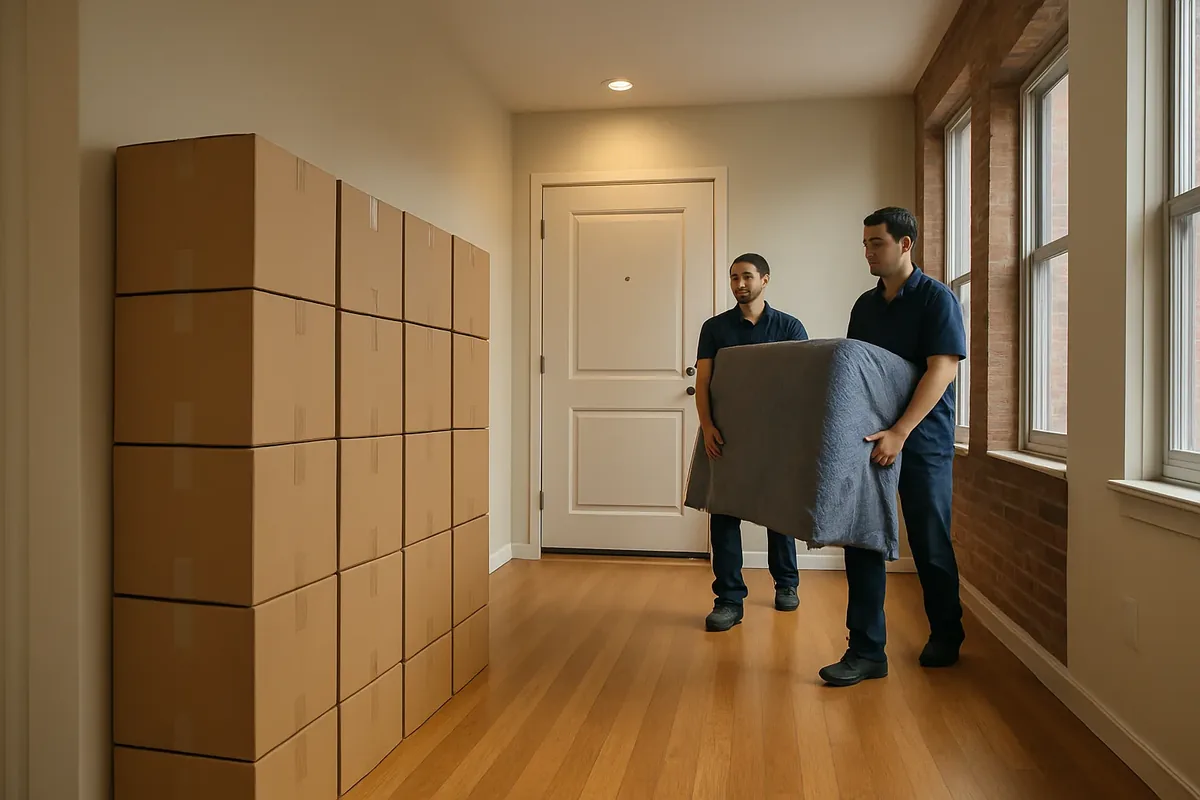
Grouping every sealed, taped box within 5 to 12 feet of your front door eliminates that friction instantly. One mover stays anchored inside your foyer feeding pre-sorted four-box columns directly onto hand trucks while the remaining one to three carriers run continuous elevator or stair relays. Saving 45 minutes on a 3-person crew billed at $175 to $235/hr cuts $131 to $176 straight off your invoice—and often prevents your move from spilling past a 2-hour building freight elevator reservation.
| Apartment Size & Volume | Crew Rate & Billable Base + Travel Hrs | Time & Labor Saved by Entry Staging | Full-Service Local Total (With Entry Staging + DIY Kit) | DIY Rental Truck + 2-Hr Loading Help Total |
|---|---|---|---|---|
| Studio (350–550 sq ft / 250 cu ft) | 2 Movers @ $125–$165/hr (4.0–5.0 hrs) | 25–35 min ($52–$96 saved) | $640 – $1,080 (incl. $75–$145 truck fee + $65–$110 kit) | $265 – $445 (10-ft truck + kit + optional 2-hr help) |
| 1-Bedroom (600–850 sq ft / 420 cu ft) | 2 Movers @ $130–$175/hr (5.0–7.0 hrs) | 35–45 min ($76–$131 saved) | $865 – $1,530 (incl. $75–$145 truck fee + $95–$160 kit) | $310 – $515 (12–15 ft truck + kit + 2-hr help) |
| 2-Bedroom (900–1,250 sq ft / 680 cu ft) | 3 Movers @ $175–$235/hr (6.0–8.5 hrs) | 45–55 min ($131–$215 saved) | $1,340 – $2,380 (incl. $75–$145 truck fee + $145–$235 kit) | $375 – $610 (15–20 ft truck + kit + 2-hr help) |
| 3-Bedroom (1,300–1,800 sq ft / 980 cu ft) | 4 Movers @ $220–$295/hr (7.5–10.5 hrs) | 50–65 min ($183–$320 saved) | $2,015 – $3,575 (incl. $75–$145 truck fee + $205–$330 kit) | $450 – $725 (20–26 ft truck + kit + 2-hr help) |
How Door-Side Staging Prevents Freight Elevator & Walk-Up Surcharges
Raw hourly rate savings tell only half the story. In mid-rise and high-rise US apartment buildings, property managers restrict moves to strict 2-hour or 3-hour reserved service elevator windows backed by a Certificate of Insurance (COI). If un-staged boxes stretch your loading time from 2.25 hours to 3.0 hours, your elevator lockoff expires and your crew gets forced into a shared passenger elevator—adding 1.0 to 1.75 extra billable hours plus an $85 to $175 shared-elevator bottleneck cost.
The same bottleneck applies on 2nd- through 5th-floor walk-ups, where stair surcharges already add $55 to $95 (2nd floor), $110 to $190 (3rd floor), or $185 to $340 (4th–5th floor). Pre-staging heavy small boxes together near the foyer lets your crew build balanced two-box hand-truck loads or pair stair carriers cleanly so nobody walks halfway down two flights carrying an under-filled linen carton while heavy book boxes remain buried in the back bedroom.
Amazon US Apartment Moving Supplies
Recommended Moving Boxes, Blankets & Bags for This Move
Apartment moving supplies matched to this guide (Amazon.com affiliate ID: apartmentmovingcost-20).
Cheap Cheap 2-Bedroom Deluxe Apartment Moving Kit with Dish & Glass Pack (42 Boxes)
42-box apartment kit featuring partitioned stemware and plate inserts for fragile kitchen cabinets
TICONN Extra-Large Heavy-Duty Moving Bags with Reinforced Wrap Handles (8-Pack)
Foldable 95-liter zippered apartment moving bags with clear tag pockets for closets and linens
Scotch Box Lock Extreme Grip Moving & Shipping Tape (6-Roll Pack)
Advanced instant-stick adhesive formulated for 100% recycled kraft and textured double-wall boxes
As an Amazon Associate I earn from qualifying purchases. Always verify live stock and pack sizing directly on Amazon.com.
The 5-Foot Foyer Zone: Staging Rules That Movers Actually Want
Piling boxes randomly directly against the front door creates a worse obstacle than leaving them in bedrooms. Experienced apartment foremen ask renters to stage boxes starting 5 to 8 feet back from the threshold along one living-room or dining-area wall, leaving a completely clear 42-inch runway for queen mattresses, three-seat sofas, and four-wheel dollies to pivot out the door.
- Preserve the Door Swing & Pivot Radius: Keep the first 5 feet behind the entry door completely clear so movers can prop the door open, lay down neoprene floor runners, and swing an 84-inch sofa past the jamb without unstacking your boxes first.
- Build Uniform 4-Foot Columns by Box Base Size: Stack identical 16×12×12 small boxes together and identical 18×18×16 medium boxes together up to chest height (~48–52 inches). Mixing wide 24-inch boxes atop narrow 16-inch cartons forces movers to unbuild your stack before sliding a dolly blade underneath.
- Put Heavy 32-ECT Book & Dish Boxes on the Bottom Tier: Bottom-load dense cartons containing hardcover books, pantry cans, and ceramic plates (35–50 lbs) so crews load the truck's heavy base wall first, and place lightweight bedding and pillow cartons on top.
- Leave Large Furniture Unblocked in Rooms: Never barricade your bed frame, dresser, or sectional sofa behind a wall of boxes. Movers typically blanket-wrap and load large casegoods and couches first or in coordinated sections—keep pathways to every bedroom unobstructed.
Box Strength & Handle Gear Built for High-Stack Door Staging
Door-side staging only speeds up your move if bottom-tier boxes survive carrying 120 to 150 pounds of upper-tier boxes stacked on top of them overnight—and if soft closet items do not bulge out of overstuffed cardboard flaps. Purchasing a matched corrugated kit alongside reinforced zippered totes prevents column collapses.
For 2-bedroom kitchens and multi-room stacks, the Cheap Cheap 2-Bedroom Deluxe Apartment Moving Kit with Dish & Glass Pack (42 Boxes) supplies 32-ECT corrugated cartons alongside partitioned stemware and plate dividers so fragile dinnerware rides safely in rigid lower-to-mid stacks without bowing. To keep heavy recycled-fiber bottom seams locked under 4-high column compression, seal every H-seam with Scotch Box Lock Extreme Grip Moving & Shipping Tape (6-Roll Pack), whose 3.1-mil extreme-grip adhesive bites instantly into 100% recycled kraft flaps without splitting along edges. For soft closet clothes, coats, and throw blankets that never belong in crush-prone large cartons, pack them into TICONN Extra-Large Heavy-Duty Moving Bags with Reinforced Wrap Handles (8-Pack); each 95-liter zippered bag holds up to 65 lbs on continuous wraparound webbing handles and stacks cleanly as a cushioned top layer on box columns or slides straight into your car trunk.
Step-by-Step Staging Timeline for the Night Before Moving Day
- Clear and Measure the 42-Inch Entry Runway First. Pull shoes, coat racks, umbrella stands, and entryway console tables out of your foyer at T-24 hours so you establish a wide, snag-free path from living room to threshold.
- Tape and Double-Check Every Bottom and Top Seam. Run two strips across bottom seams and a full H-seal on top flaps using 3.1-mil box-lock tape; unsealed or folded-interlock flaps collapse when stacked four high on a four-wheel skate.
- Group Boxes into Three Dedicated Staging Zones. Align Column Row A with heavy small/dish boxes, Row B with medium room boxes, and Row C with light linen cartons and zippered moving bags—all facing outward with room labels visible.
- Stage Disassembled Hardware & Overnight Bag Separately. Place taped hardware bags, router cords, lease keys, and your overnight suitcase inside your closed bathroom or closet with a bright note so movers do not accidentally bury them in the truck nose.
- Confirm Furniture Clearances Before Crew Check-In. Walk each bedroom and the living room to confirm zero staged boxes sit within 3 feet of sofas, dressers, or bed frames that movers must blanket-wrap before box loading begins.
Calculate exactly how much hourly labor door-side staging saves on your apartment size and floor access in our Apartment Moving Cost Calculator, or compare full-service vs. DIY truck budgets in our Movers vs. DIY Rental Truck Comparator.
Open Calculator →Frequently Asked Questions
How close to the front door should I stage moving boxes?+
Keep a clear 5-to-8-foot radius immediately inside your front door so movers can prop the door open, lay floor runners, and pivot long sofas out cleanly. Build your box stacks starting 5 feet back along one living-room or foyer wall while keeping a 36-to-42-inch walking aisle.
Do movers want boxes stacked before furniture, or furniture moved first?+
Most apartment crews load large wrapped furniture (sofas, dressers, mattresses) into the front wall of the box truck first, or tier furniture tightly with heavy base boxes underneath. Staging boxes along a side foyer wall keeps them out of the furniture path while allowing movers to grab boxes immediately whenever they need filler tiers.
How high can I safely stack 32-ECT cardboard moving boxes in my apartment?+
Standard 32-ECT single-wall moving boxes safely stack 4 boxes high (about 48 to 54 inches) overnight if each box is packed completely full to the top seam with zero hollow air pockets and heaviest items placed on the bottom tier. Hollow, half-empty boxes buckle overnight under stacked weight.
Will California Double Drive Time (DDT) or a 1-hour travel fee negate staging savings?+
No—travel fees (typically 1.0 hour flat locally, or California CPUC Double Drive Time billing double the driving time between origin and destination) are fixed transport components. Cutting 45 minutes of loading time inside your apartment directly shrinks on-site billable clock hours as long as your move exceeds the carrier's 2- or 3-hour minimum.
Are movers allowed to carry open or unsealed boxes down stairs?+
No. Full-service movers generally refuse to stack unsealed or bulging open-top boxes on dollies or inside trucks because contents spill on stairs and violate carrier valuation terms. Everything staged near the door should be taped flat and sealed before the crew arrives.
Interactive US Moving Tools
Compare Full-Service Movers vs. DIY Rental Truck in 30 seconds
Related Guides
apartment moving cost guides
Apartment Moving Cost Guides: Complete US Hourly Rates, Flat-Rate Quotes & Benchmarks
Local US apartment moves with licensed full-service crews average $640 to $1,530 for studios and 1-bedroom units and $1,270 to $3,572 for 2- and 3-bedroom apartments when self-packed, while DIY rental trucks run $155 to $507. This pillar guide decodes hourly crew math, travel fees, access surcharges, FMCSA estimate rules, and packing material ratios across every moving scenario.

apartment moving cost guides
Color-Coded Box Labels: Why Visual Room Routing Cuts Unloading Crew Hours by 20%
Replacing scribbled marker labels on top box flaps with dual-corner color-coded room tape or stickers trims 20% off destination unloading time, saving $70 to $220 in hourly apartment mover billing. See the exact room-color routing system, freight elevator payoff math, and tape specs that prevent label peeling.
apartment moving cost guides
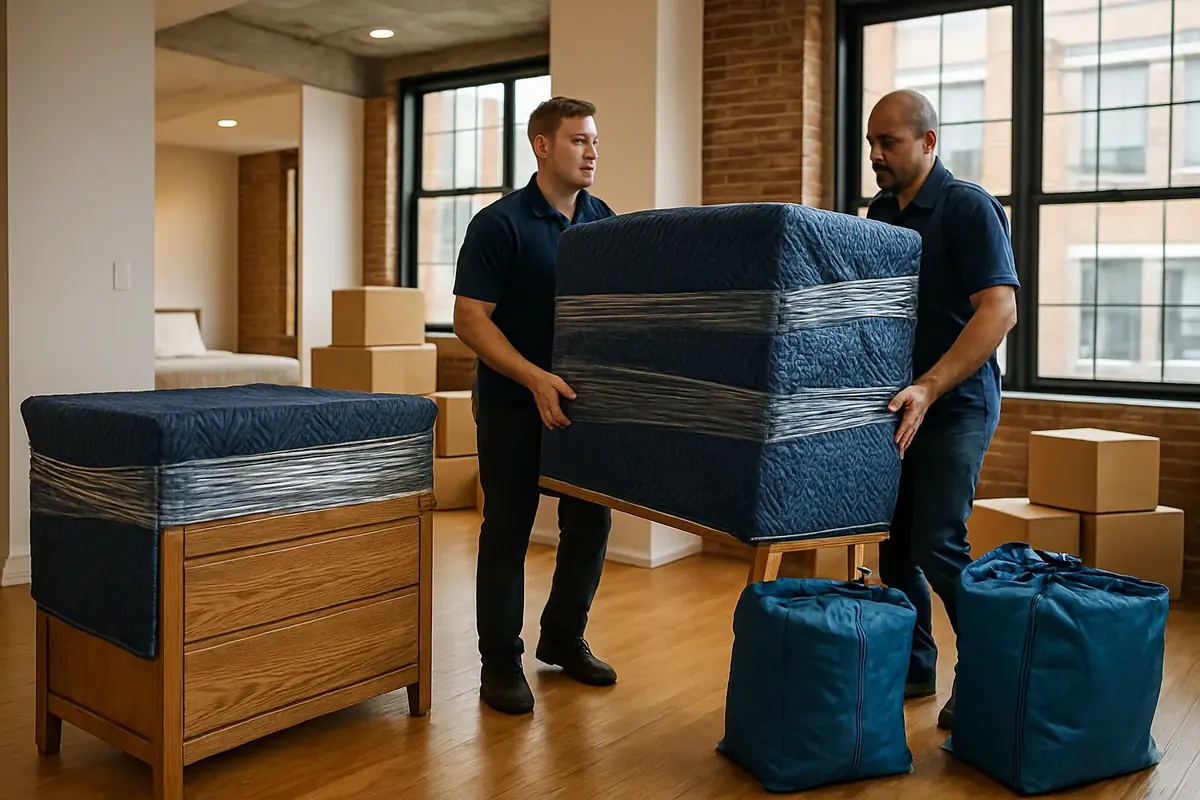
Leaving Clothes Inside Dresser Drawers: Furniture Weight, Joinery & Stretch-Wrap Rules
Leaving clothes inside dresser drawers can eliminate 4 to 6 moving boxes ($20–$45 DIY or $90–$160 mover-packed), but doing so in MDF particleboard furniture or on walk-up stairs frequently snaps drawer glides and voids valuation coverage. Learn the exact joinery, stair, and blanket-first stretch-wrap rules used by US apartment movers.
apartment moving cost guides
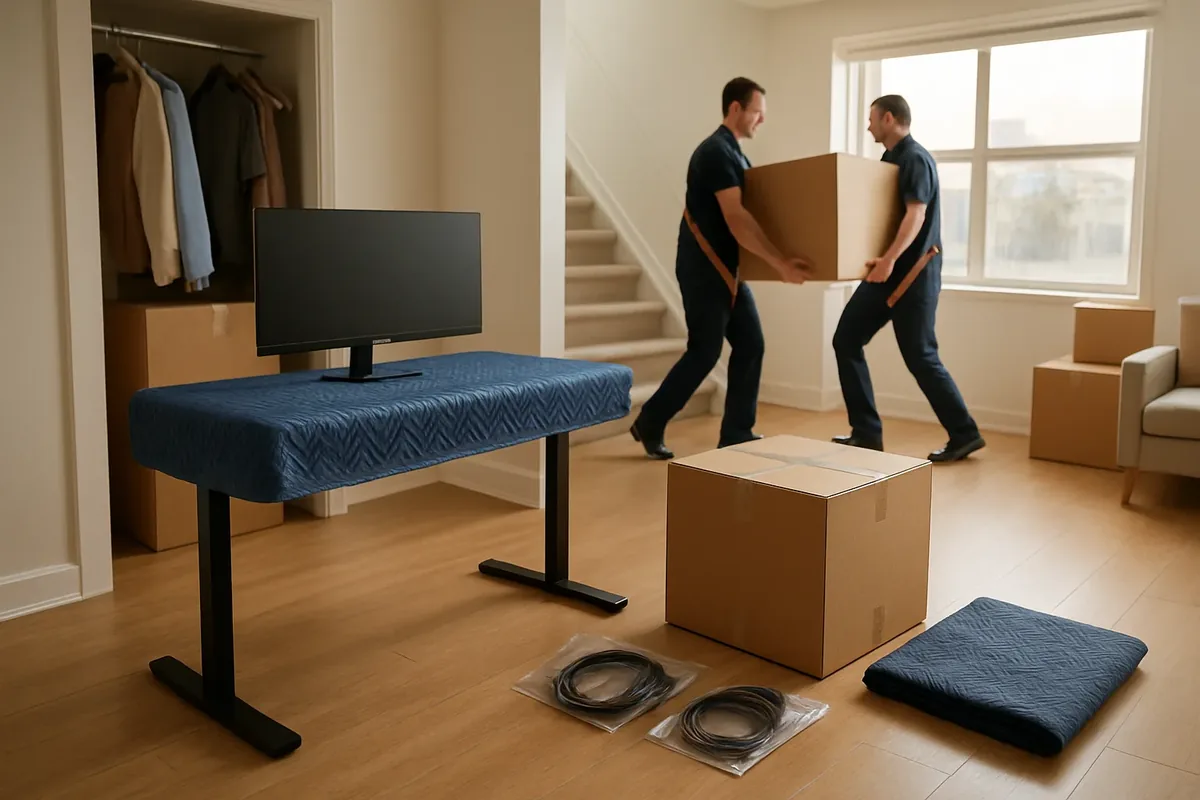
Home Office Desk & Dual-Monitor Prep: How Disconnecting Early Saves $100+ in Crew Time
Pre-disconnecting dual monitors, VESA arms, Thunderbolt docks, and sit-stand desks before movers arrive shaves 35 to 55 minutes off hourly crew billing ($80–$145 saved) while eliminating $350+ panel-crack risks covered at just $0.60/lb. Follow this port-photo, screen-padding, and hardware-bagging workflow to protect your home office budget.